
📋 Table of Contents
- 1.Why ‘Pajeon + Makgeolli’ on a Rainy Day? Unpacking the Korean Phenomenon
- 2.The Psychological and Physiological Link to Rainy Day Cravings
- 3.The Sizzling Sound Connection: A Pavlovian Response?
- 4.Tracing the Tradition: From Joseon Farmlands to Your Table
- 5.The Hidden Health Benefits: Pajeon and Makgeolli Through an Eastern Lens
- 6.My Unforgettable First Makgeolli Moment: More Than Just a Drink
Do you ever wonder why certain foods just feel right on specific days? For me, the question of why Koreans instinctively reach for Pajeon (파전, Korean green onion pancake) and Makgeolli (막걸리, Korean rice wine) on a rainy day always puzzled me. I remember my first time trying this combination in my late twenties. The rain was drumming outside, and inside, the sound of the pajeon sizzling on the pan seemed to perfectly synchronize with the raindrops. It was magical, honestly!
The savory aroma of the batter, the pungent kick of green onions, and the sweet, tangy, yet smooth taste of makgeolli – it was an instant love affair. But it made me think, why this particular pairing? Why does this specific image pop into every Korean’s mind when it rains? Today, I want to explore this question from various angles: psychological, physiological, cultural, and even historical. Let’s dig in and find out together!
Why ‘Pajeon + Makgeolli’ on a Rainy Day? Unpacking the Korean Phenomenon
It’s almost an unwritten rule in Korea: when it rains, you eat pajeon and drink makgeolli. I mean, we’ve all seen the social media posts, right? Search any Korean portal or food delivery app during a downpour, and you’ll notice a definite spike in pajeon orders. It’s truly become an idiom, a common saying, a shared sentiment across generations, even among the MZ generation.
We often hear phrases like, “It’s raining, so pajeon and makgeolli, anyone?” or “When the monsoon season starts, I just crave jeon (pancakes).” It’s a combination that almost 99% of Koreans know, yet perhaps 99% might not precisely know *why* we eat it. Media plays a huge role in this too. Think about how many K-dramas, variety shows, and commercials feature characters folding their umbrellas and heading into a restaurant for a plate of sizzling jeon and a glass of makgeolli. These scenes constantly reinforce this iconic image, making it even more ingrained in our collective consciousness.
Shared Korean Sentiment 📝
- Increased Orders: Food delivery data often shows a surge in pajeon orders on rainy days.
- Common Idiom: “Rainy day = Pajeon” is almost a universal phrase.
- Media Reinforcement: K-dramas, shows, and ads frequently feature this food pairing.
- Generational Appeal: Even younger generations (MZ) share this cultural craving.
It’s not just a passing trend; it’s a deeply rooted cultural phenomenon that we all participate in, often without fully understanding its origins. Now, let’s explore the deeper reasons behind this delightful tradition!
The Psychological and Physiological Link to Rainy Day Cravings
Have you ever noticed that when it rains, you just feel… a little down? Or maybe extra hungry? It’s not just in your head! When clouds and rain block the sunlight, our bodies produce less serotonin, the “happy hormone.” This can lead to feelings of gloominess or lethargy. I know I definitely feel that way sometimes!
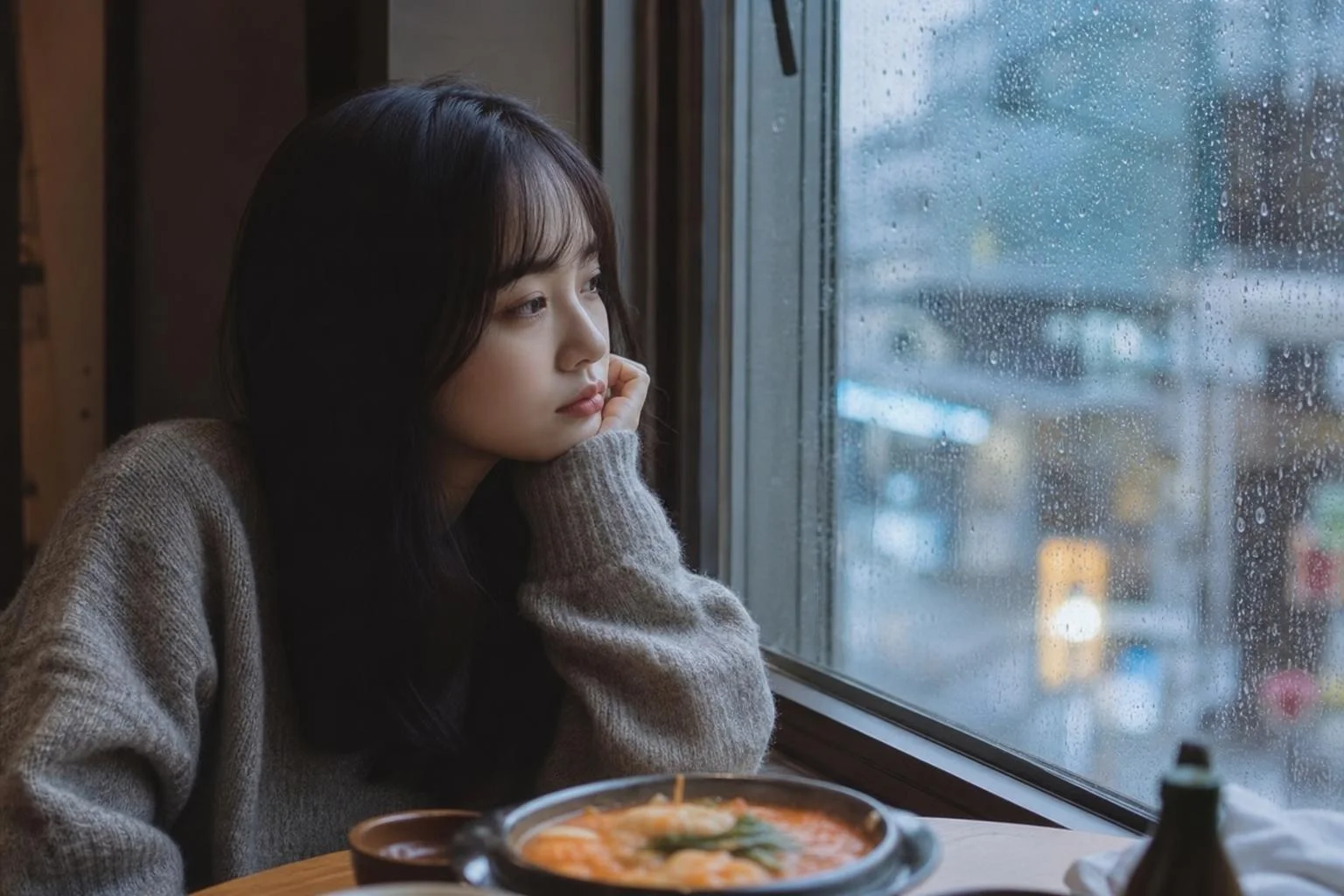
A Korean person is feeling a bit down on a rainy day, craving comfort food.
Government policy briefings and health articles often point out that over 80% of people report increased appetite on cloudy days, according to some obesity clinic surveys. This is because we tend to seek out carbohydrate-rich and high-calorie foods to boost our mood. Plus, the cooler temperatures on rainy days make our bodies work harder to maintain warmth, increasing metabolism and stomach acid, which can make us feel hungrier!
Lower atmospheric pressure during rain can also cause blood sugar levels to drop, making us crave savory, oily foods like pajeon – a perfect mix of carbs and fat!
Many health columns emphasize that the starch in flour, a key ingredient in pajeon, quickly converts to glucose, raising blood sugar. This process also helps synthesize serotonin, temporarily uplifting our mood. So, eating a warm, high-calorie food like pajeon on a chilly, damp day helps compensate for both the drop in body temperature and mood. It’s a clever little biological trick our bodies play on us!
The Sizzling Sound Connection: A Pavlovian Response?
Here’s a fun one: have you ever noticed how similar the sound of rain falling is to the sound of pajeon sizzling on a hot pan? It’s not just a poetic comparison; several Q&A forums, blogs, and news articles frequently mention this! I always thought it was just me, but apparently, it’s a widely recognized connection.
A past broadcast experiment even revealed that the frequency of raindrops and the sound of jeon cooking are about 90% identical! This isn’t just a coincidence; it scientifically supports how similar these sounds truly are. Psychologists would call this “associative learning” or a “Pavlovian conditioned response.”
The Pavlovian Pajeon Effect 🧠
- Repeated Experience: We repeatedly experience eating pajeon on rainy days.
- Sensory Connection: The sound of rain becomes linked with the sizzling of pajeon, its aroma, and warmth.
- Conditioned Response: Eventually, just hearing the rain unconsciously triggers memories of pajeon, making us crave it!
So, it’s not just a “feeling.” The sound of rain acts as a trigger, bringing back a whole package of memories: the smell of oil, the warmth, and the cozy feeling of sharing food with family or friends. It’s a powerful psychological connection, built over years of shared experiences!
Tracing the Tradition: From Joseon Farmlands to Your Table
To truly understand why pajeon on rainy days is such a big deal, we need to go way back to the Joseon (조선) Dynasty, a time when Korea was primarily an agricultural society. When heavy rains came, farmers couldn’t work in the fields. This meant they had a rare opportunity to rest indoors, a “temporal luxury” they didn’t often get.
During these breaks, they would use leftover vegetables and grains from their homes to make bindae-tteok or buchimgae (types of pancakes), establishing a natural rural food culture. This practice was not just about food; it was about taking a break, making the most of what they had, and enjoying a communal meal. It reminds us how deeply food can be tied to our daily lives and history.
| Rainy Day Activities in Joseon | Modern Day Equivalent |
|---|---|
| Farmers paused fieldwork. | Indoor activities (movies, games). |
| Used leftover ingredients for pancakes. | Ordering delivery or cooking comfort food. |
| Shared food with family and neighbors. | Gathering with friends for a meal. |
And what about makgeolli? Back then, it wasn’t just a casual drink. It was considered a restorative beverage or even medicine for farmers to regain their strength during busy farming seasons. Packed with carbohydrates, proteins, vitamins, and amino acids, makgeolli was a high-calorie fermented drink vital for sustaining a day’s hard labor. So, the tradition of gathering with family and neighbors to share pancakes and makgeolli on a rainy day, when work paused, naturally evolved into the custom we know today!
The Hidden Health Benefits: Pajeon and Makgeolli Through an Eastern Lens
It turns out that the pajeon and makgeolli combination isn’t just delicious; it also has some surprising health benefits, especially for a rainy day! Let’s look at the ingredients.
Pajeon & Makgeolli: A Nutritional Duo 🌿
- Green Onions (파): In traditional Korean medicine, green onions are known to warm the body, boost “yang” energy, and improve blood circulation, helping with early cold symptoms. Perfect for a chilly, damp day!
- Flour (밀가루): Rich in starch, it quickly raises blood sugar and provides B vitamins and amino acids needed for serotonin production, giving us a mood lift.
- Seafood (해물): Ingredients like squid and shrimp offer protein, taurine, and minerals, providing sustained fullness and helping with fatigue recovery.
- Makgeolli (막걸리): This fermented rice wine contains lactic acid bacteria and dietary fiber, which help balance the “cold” nature of flour and aid digestion. It also provides B vitamins and amino acids, enhancing the mood-boosting effect.
While flour is considered “cold” in traditional Korean medicine and might cause digestive issues if eaten too much, makgeolli steps in as the perfect partner! Its rich lactic acid bacteria and dietary fiber help to complement and support digestion. So, it’s not just a tasty treat; it’s a “reasonable comfort food” that tackles the low temperature, gloom, and fatigue of a rainy day, both traditionally and nutritionally!
My Unforgettable First Makgeolli Moment: More Than Just a Drink
Thinking back to my first makgeolli experience on that rainy day, it truly was more than just enjoying a meal. It was a moment where my senses were fully engaged, and my mood shifted. The savory, crisp pajeon, fresh off the griddle, combined with the slightly sweet and tangy makgeolli, created an explosion of flavors that I’d never quite experienced before. It was simple, yet profoundly satisfying.
What really struck me was how the conversation flowed so easily around that table. The cozy atmosphere, the gentle patter of rain outside, and the shared warmth of the food and drink created a perfect setting for genuine connection. It wasn’t just about filling my stomach; it was about the communal experience, the simple joy of being present, and the comfort that this traditional pairing brought. It felt like a little slice of Korean life, perfectly encapsulated in a rainy afternoon. Honestly, it changed how I viewed rainy days forever!
Key Takeaways: Pajeon & Rainy Days
📚 Recommended Reading
Frequently Asked Questions ❓
So there you have it! The next time you find yourself craving pajeon and makgeolli on a rainy day, you’ll know it’s not just a random craving. It’s a beautiful blend of psychology, physiology, a rich history from the Joseon era, and even clever nutritional synergy. It’s a tradition deeply woven into the fabric of Korean culture, offering comfort and connection when the skies open up.
I hope my own first experience and this deep dive have helped you understand this beloved Korean tradition a little better. It’s truly amazing how food can connect us to so many different aspects of life, isn’t it? If you have any more questions or want to share your own rainy day food traditions, please feel free to leave a comment below!