
📋 Table of Contents
Hey everyone! Are you planning a trip to Korea and feeling a little overwhelmed by how to get around? I know, it can seem a bit tricky at first, especially when it comes to figuring out the subway payment system. Many of us worry about buying the wrong card or not knowing how to use it.
But don’t you worry! Korea’s public transportation is actually super efficient and easy to use once you know the basics. It’s one of the best ways to explore the country. Today, I’m going to walk you through everything you need to know about Korea subway payment, specifically for us foreign users. Let’s dive in!
Key Points for Korea Subway Payment
Understanding Korea’s Subway Payment System
When you first arrive in Korea, you’ll quickly realize that cash isn’t king for public transport. Instead, they primarily use a card-based system. This makes everything super fast and efficient, which is great when you’re trying to catch your train!
The subway system here is vast and connects almost every corner of major cities like Seoul (서울). Understanding how to pay isn’t just about buying a ticket; it’s about unlocking a whole network of convenience. What’s more, these cards aren’t just for the subway; they work on buses too, and even in some taxis and convenience stores!
Why Card Payment is Best 📝
- Speed: Quick taps at turnstiles mean no waiting in line for tickets.
- Convenience: Usable across multiple transport types (subway, bus, taxi).
- Discounts: Enjoy free transfers between subway and bus, which saves you money!
- Simplicity: No need to calculate fares for each ride; the system does it for you.
So, the main takeaway here is that you’ll definitely want to get a transit card for your trip. It’s the most straightforward way to handle your Korea subway payment needs. It truly makes traveling around the city a breeze.
Your Essential Travel Companion: T-money Card
Okay, let’s talk about the star of the show: the T-money card. This is probably the most famous and widely used transit card in Korea, especially for visitors. Think of it like your all-in-one key to public transport!
The T-money card (티머니 카드) is super simple to use. You just load money onto it, and then tap it when you enter and exit the subway or bus. It automatically calculates your fare, so you don’t have to worry about figuring out how much each trip costs. I actually found it much easier than buying single-use tickets every time.
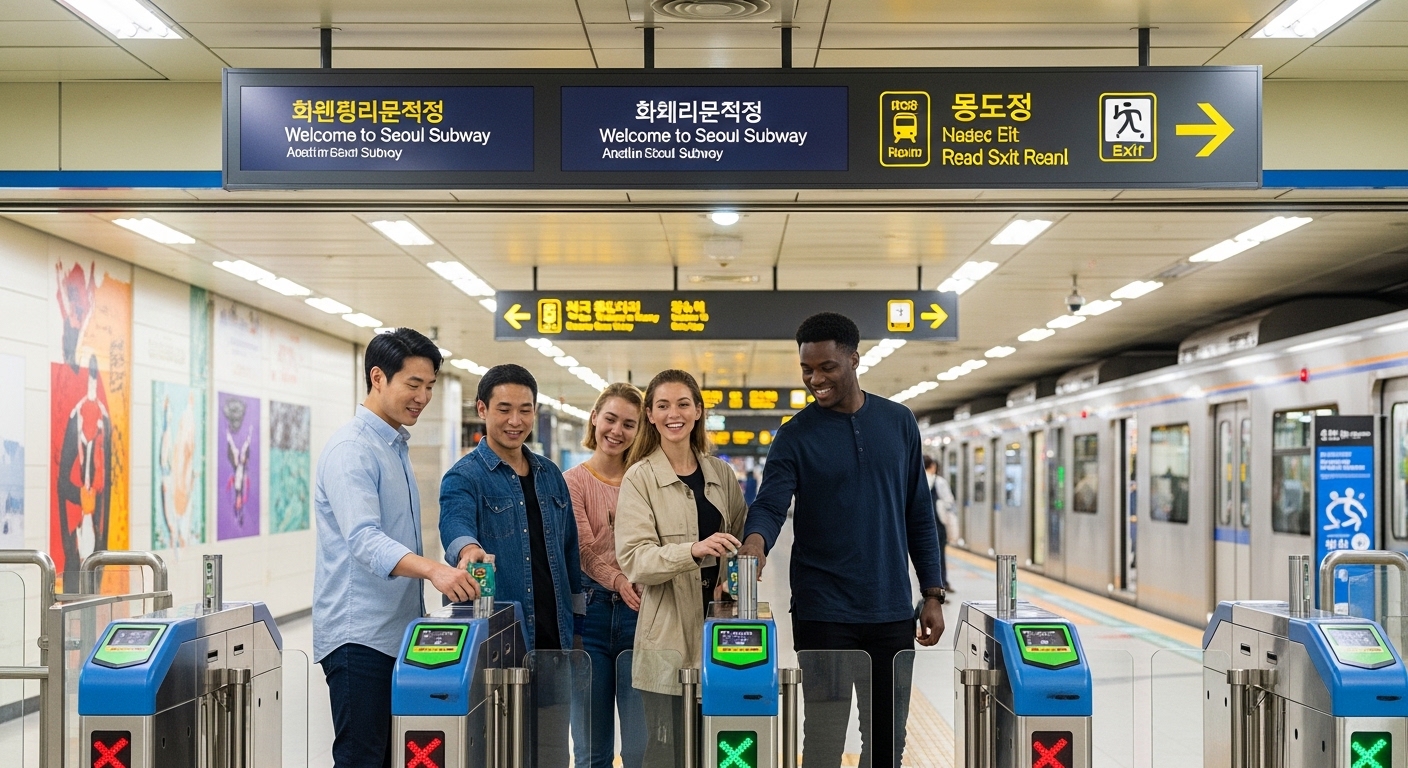
People tapping T-money cards at a Seoul subway station.
How to Get and Recharge Your T-money Card 📝
- Purchase: You can buy a T-money card at any subway station (from ticket vending machines or information booths) and at most convenience stores (like GS25, CU, 7-Eleven). It usually costs about 2,500 to 5,000 Korean Won (KRW) for the card itself.
- Recharge: To add money, go to the same places – subway station vending machines or convenience stores. The vending machines often have English options, making it easy. Just select “Recharge,” place your card, insert cash (they usually don’t accept credit cards for recharging), and you’re good to go!
It’s a good idea to keep a decent amount of money on your T-money card, especially if you plan on traveling a lot. This way, you won’t have to worry about recharging in the middle of a busy day.
Beyond T-money: Other Payment Options for Foreigners
While the T-money card is fantastic, there are other cool options for foreigners that might fit your travel style better! Knowing about these can really enhance your Korea subway payment experience.
For example, the Trazy Blog mentions the WOWPASS (와우패스) and Discover Seoul Pass (디스커버 서울 패스). These aren’t just transit cards; they come with additional benefits like discounts on attractions or even acting as a prepaid debit card.
Consider your travel duration and planned activities. If you’re staying for a short period and visiting many attractions, a pass like the Discover Seoul Pass might save you money!
Alternative Transit Options 📝
| Card Name | Main Feature | Ideal For |
|---|---|---|
| T-money (티머니) | General transit card for subway, bus, taxi. | All travelers, especially long-term stays. |
| WOWPASS (와우패스) | Prepaid debit card + T-money functionality. Exchange foreign currency directly. | Travelers who want to manage expenses easily and use it for shopping. |
| Discover Seoul Pass (디스커버 서울 패스) | Free entry to major attractions + T-money function. (1, 2, or 3-day options). | Tourists focused on sightseeing in Seoul. |
Even Apple Pay (애플 페이) is making its way into Korea transit! While it’s not universally accepted everywhere yet, it’s a growing option that offers convenience for those who prefer to use their phones. Just always double-check the acceptance at your specific station or bus.
How to Use Your Card: Tapping In and Out
Using your transit card for Korea subway payment is pretty straightforward, but there’s one golden rule: always remember to tap out! This is super important because it ensures you’re charged the correct fare and helps the system track passenger flow.
When you enter a subway station, you’ll see turnstiles. Just hold your card flat against the sensor. You’ll hear a “beep” and see your remaining balance displayed. Do the same when you exit. If you forget to tap out, the system assumes you traveled the maximum distance and might charge you a higher fare next time you tap in. Nobody wants that!
Step-by-Step Card Usage 📝
- Entering the Subway: Find a turnstile. Hold your card on the designated sensor (usually marked with a card icon). Wait for the “beep” and the green arrow, then walk through. Your balance will show.
- Exiting the Subway: At your destination, find an exit turnstile. Tap your card on the sensor again. You’ll see your deducted fare and remaining balance. If you don’t tap out, you might face issues later!
- Using on Buses: Tap when you board the bus. Tap again when you get off. Even if the bus is crowded, try your best to tap out – it’s key for transfer discounts.
One thing I noticed is how fast people tap. Don’t feel rushed! Just make sure your card is flat and you hear the beep. It becomes second nature after a few tries.
Tips for a Smooth Ride: Transfers and Fare Saving
Now that you know the basics of Korea subway payment, let’s talk about some smart tips to make your journey even smoother and save a bit of money. Korea’s public transport system is designed to be efficient, and that includes easy transfers!
The biggest perk of using a transit card like T-money is the free transfer system. If you transfer between the subway and a bus (or vice-versa) within a certain time limit (usually 30 minutes, 1 hour during late nights), your next ride is often free or heavily discounted. This is a huge money-saver, especially if you’re exploring different neighborhoods.
Always check your route on a navigation app like KakaoMap (카카오맵) or Naver Map (네이버 지도). These apps provide real-time information, tell you exactly where to transfer, and even estimate your fare!
Maximizing Your Transit Experience 📝
- Mind the Transfer Window: Make sure you tap out and tap into your next mode of transport within the given time frame to get your transfer discount.
- Plan with Apps: Use local navigation apps. They’re excellent for directions, estimated travel times, and even telling you which subway exit to use.
- Off-Peak Travel: If possible, travel during off-peak hours to avoid the busiest crowds. Korean subways can get very packed during rush hour!
I found that using these apps really made my travel stress-free. There’s nothing worse than getting lost or missing a transfer, right? A little planning goes a long way!
Troubleshooting Common Payment Issues
Even with the best preparation, sometimes things don’t go exactly as planned. Don’t worry, it happens to everyone! Here are some common Korea subway payment issues you might encounter and how to deal with them.
The most common problem is insufficient balance. If your card doesn’t have enough money, the turnstile won’t let you through. You’ll hear a different sound and see a red “X.” It’s a clear signal to recharge your card. Don’t panic, just head to the nearest recharge station.
Forgetting to tap out is a common mistake. If you do this, your card may be blocked, or you might be charged the maximum fare. If you realize you forgot, speak to a station attendant at your next destination.
Quick Fixes for Payment Problems 📝
- Insufficient Balance: Immediately recharge your card at a subway station machine or convenience store.
- Card Not Tapping: Ensure your card is flat against the sensor and not bent or damaged. Try a different turnstile.
- Forgot to Tap Out: Find a station attendant (usually near the ticket gates or information booth) and explain your situation. They can often fix the issue.
- Lost Card: Unfortunately, T-money cards are typically not registered to individuals unless specifically done so. If lost, the balance is gone. Consider a registered card for longer stays.
The staff at subway stations are generally very helpful, even if they don’t speak perfect English. A little bit of gesturing and a friendly smile can go a long way when you need assistance.
So there you have it, your complete guide to Korea subway payment! I hope this helps you feel more confident and excited about using public transport during your visit. With your T-money card or other chosen option, you’re all set to explore Korea like a local. If you have any more questions or tips, feel free to leave a comment below!