

📋 Table of Contents
- 1.7-Eleven’s Global Roots: From Ice to Convenience
- 2.7-Eleven’s Journey to Korea: A Partnership with Lotte
- 3.Korea Seven: Building the Convenience Store Landscape
- 4.Lotte Group’s Strategic Move: Acquiring Buy the Way
- 5.7-Eleven Korea’s Growth and Market Leadership
- 6.Innovation in Convenience: The Yeoksam-dong 2-Story Store
- 7.Celebrating 37 Years: Future Strategies and Global Links
Have you ever wondered about the history of 7-Eleven in Korea? I mean, it feels like it’s always been there, right? But like many global brands, its journey to the Korean Peninsula is quite an interesting one.
From its humble beginnings as an ice company in the US to becoming a massive convenience store empire, 7-Eleven has certainly made its mark. And in Korea, it wasn’t just a simple entry; there were partnerships, withdrawals, and strategic acquisitions involved.
So, what actually happened? How did 7-Eleven Korea grow to be one of the biggest convenience store chains, with thousands of stores across the country? Let’s dive into the fascinating story of 7-Eleven Korea and explore its journey, innovations, and future plans. It’s quite a tale!
Key Takeaways about 7-Eleven Korea
7-Eleven’s Global Roots: From Ice to Convenience
You know, it’s pretty wild to think that 7-Eleven started out selling ice. Yes, really! The story begins way back in 1927 in Dallas, Texas, with a company called Southland Ice Company. It was just an ice storage facility, but a clever employee named John Jefferson Green had a brilliant idea.
He realized people needed more than just ice. So, he started selling essentials like milk, bread, and eggs right from the ice dock. This simple act of convenience was actually the very first step towards what we now know as a convenience store! Isn’t that fascinating?
Key Milestones in 7-Eleven’s Early History 📝
- 1927: John Jefferson Green starts selling basic groceries from a Southland Ice Company ice house in Dallas.
- 1928: The stores are officially named ‘Tote’m Stores’, inspired by customers ‘toting’ away their purchases.
- 1946: Rebranded to ‘7-Eleven’ to reflect new operating hours (7 AM to 11 PM).
- 1963: The first 24-hour operation is introduced in Austin, Texas, which later becomes a global standard for convenience stores.
From those early days, the concept of convenience quickly spread, and the name 7-Eleven stuck because of its extended operating hours. And let me tell you, when they introduced 24-hour service, it totally changed the game for customers worldwide.
7-Eleven’s Journey to Korea: A Partnership with Lotte
Now, let’s fast forward to Korea. 7-Eleven’s path to the Korean market wasn’t a straight line; it had its ups and downs. The initial spark happened in July 1981 when the US-based Southland company proposed a partnership to Lotte Shopping to introduce the convenience store concept.
They did all the necessary consumer surveys and location analyses in 1982, but ultimately, the investment wasn’t deemed mature enough, and the plan was withdrawn in 1984. It felt like a missed opportunity, didn’t it? But, as they say, good things come to those who wait.
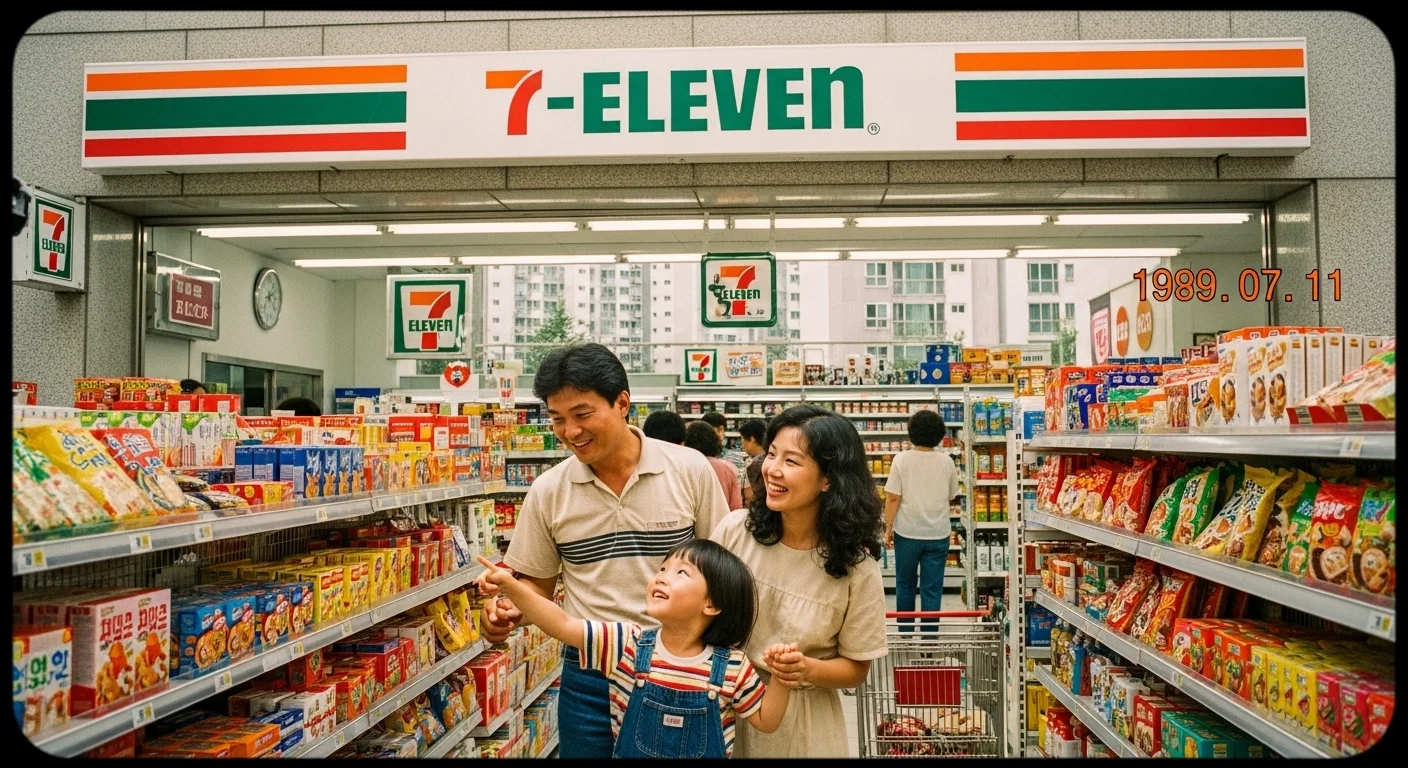
A nostalgic look at the first 7-Eleven store in Korea.
Eventually, 7-Eleven made its official debut in Korea! On May 21, 1988, Southland partnered with Korea Xerox to establish Korea Seven. And then, in 1989, the very first 7-Eleven store in Korea, named ‘7-Eleven Olympic Village,’ opened its doors in the Olympic Athletes’ Village apartment complex in Songpa-gu, Seoul. It was a big moment for the domestic retail scene!
Korea Seven: Building the Convenience Store Landscape
So, Korea Seven was officially established on May 21, 1988. This company isn’t just about running 7-Eleven stores; it also handles wholesale distribution of various products. It’s a pretty big operation, with over 2,340 employees and total assets of about 2.5 trillion Korean Won!
After the first store opened in Songpa-gu in 1989, the number of 7-Eleven outlets really started to pick up in the 1990s. This was largely thanks to the growing popularity of convenience food culture in Korea. You know, grab-and-go meals, quick snacks – they really appealed to people.
Initially, 7-Eleven stores in Korea were primarily located in downtown areas and university districts, catering mostly to middle and high school students, as well as young adults in their twenties. It was all about being where the young, active crowd was!
It’s incredible to see how the convenience store concept, pioneered by 7-Eleven in Korea, became such an integral part of daily life. They really did lay the groundwork for the modern convenience store experience we have today.
Lotte Group’s Strategic Move: Acquiring Buy the Way
The story of 7-Eleven Korea took another significant turn in 2010. This is when the Lotte Group, which had initially been approached by Southland back in the 80s, made a huge strategic move. They acquired the Buy the Way convenience store chain.
This acquisition wasn’t just about buying a competitor; it was about integration and rebranding. Lotte took all 1,000 Buy the Way stores and rebranded them as 7-Eleven outlets. This move was a big deal for Lotte, as it marked their re-entry into the CVS (Convenience Store) business and really helped them solidify their position as a leader in the domestic convenience store market.
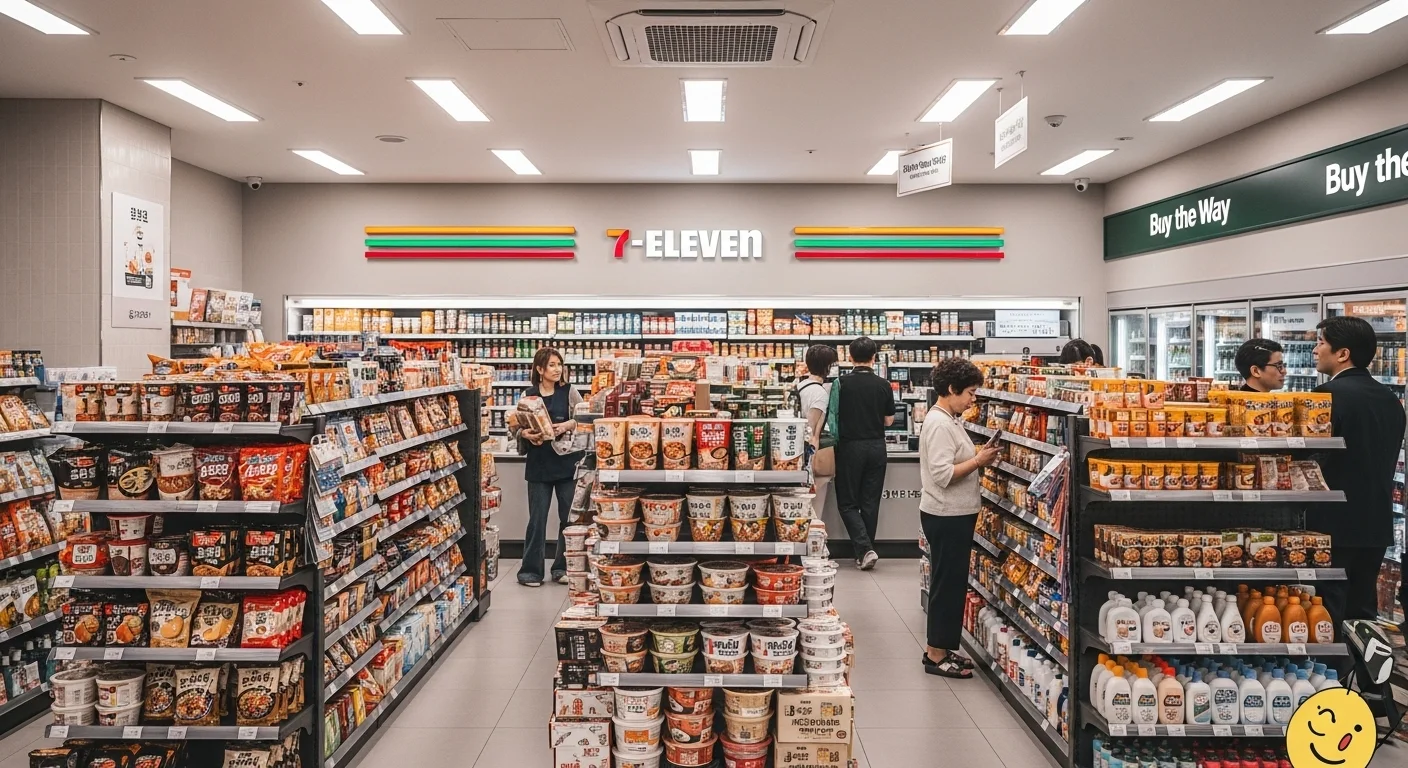
A look inside a rebranded 7-Eleven store after Lotte’s acquisition.
Interestingly, that very first 7-Eleven store in Songpa-gu, the one that opened in 1989, is still operating today! It’s a testament to the brand’s enduring presence and its deep roots in the Korean market. This acquisition really strengthened 7-Eleven Korea’s footprint and made it an even more recognizable name across the country.
7-Eleven Korea’s Growth and Market Leadership
You know, when we talk about convenience stores, 7-Eleven Korea is definitely a big player. As of 2022, there were an astonishing 11,067 7-Eleven stores across South Korea! This makes Korea the 4th largest market for 7-Eleven globally, following Japan (21,210 stores) and Thailand (13,840 stores). That’s a huge number, right?
Since its debut in 1989, 7-Eleven has really cemented its position as one of the most recognized global convenience store franchises here. They started out catering to students and young adults in city centers and university areas, but their strategy has evolved.
Expanding Reach 🗺️
7-Eleven Korea has successfully expanded its presence into residential areas and apartment complexes. This strategic shift has significantly increased usage among housewives and office workers, making convenience stores a go-to for daily needs, not just quick snacks for students.
This expansion into diverse areas really shows how much 7-Eleven has adapted to the Korean lifestyle. It’s not just a place for a quick stop anymore; it’s a part of the community, serving various needs for a broader range of customers.
Innovation in Convenience: The Yeoksam-dong 2-Story Store
7-Eleven Korea isn’t just about expanding numbers; they’re also big on innovation. A great example of this is the special store that opened on November 26, 2014, in Yeoksam-dong, Gangnam-gu, Seoul. It’s a two-story convenience store, uniquely designed as a ‘Lunch Box Cafe Convenience Store.’
This store is directly managed by the headquarters and has even been used as a location for commercials and promotional videos. It really highlights the trend of convenience stores becoming larger and more multi-functional in Korea. It’s a far cry from the tiny experimental store that opened in Sindang-dong back in 1982, which was only 132 square meters!
Beyond Basic Convenience 🚀
- Large Scale: Moving towards bigger formats, offering more space and product variety.
- Multi-functional: Integrating cafes, dining areas, and even event spaces.
- Customer Experience: Focusing on creating a comfortable and diverse experience, not just quick transactions.
- Brand Hub: Utilizing unique stores for marketing and brand building.
These innovative stores show that 7-Eleven Korea is constantly thinking about how to provide more than just basic convenience. They’re shaping the future of urban retail and creating spaces that truly cater to the dynamic needs of modern customers. It’s pretty cool, if you ask me!
Celebrating 37 Years: Future Strategies and Global Links
So, 2025 marks a special year for Korea Seven – it’s their 37th anniversary as a pioneer in the domestic convenience store industry! To celebrate, they’ve announced various customer appreciation events. Kim Min-jung, the Head of Marketing, stated that they will “continue innovative activities while repaying customer love.”
It’s clear that 7-Eleven Korea is committed to maintaining its market leadership by leveraging its global heritage. This means we can expect to see a lot of unique products and promotions that highlight its international roots while still catering to local tastes. That’s a smart strategy, right?
Global Network Advantage 🌐
- Enhanced Trading: Korea Seven actively strengthens its trading business by utilizing the extensive global 7-Eleven network.
- Product Diversification: For example, they expanded their import of daily wines, like Barefoot Wine, in June 2023.
- Global Synergy: Being part of Seven & I Holdings (under Japan’s Ito-Yokado since 2005) allows them to connect with American and Asian markets, boosting their competitiveness in Korea.
It’s really interesting to see how a local company, even with a global brand, uses international connections to bring new and exciting things to the Korean market. This global synergy is definitely a key factor in 7-Eleven Korea’s continued success and evolution.
📚 Recommended Articles
So there you have it – the incredible journey of 7-Eleven Korea! From an American ice company to a global convenience store giant, its path in Korea has been filled with innovation, strategic partnerships, and continuous growth. It truly has become an indispensable part of Korean daily life.
I hope this deep dive gave you a fresh perspective on this familiar brand. If you have more questions or anything else you’re curious about, feel free to leave a comment below. I’d love to hear your thoughts!