
📋 Table of Contents
- 1.South Korea’s Waste Management System Explained
- 2.Understanding the Volume-Based Waste Fee (VBWF) System
- 3.Different Types of Waste: General, Recyclable, Food, and Bulky
- 4.Detailed Recycling Steps and Sorting Guidelines
- 5.Specialized Handling for Food Waste
- 6.Disposing of Bulky and Large Items
- 7.Checking District-Specific Schedules and Collection Times
- 8.Environmental Impact and Future Advancements in Waste Management
Moving to a new country can be exciting, but also a little overwhelming, right? One of the things that often makes people scratch their heads is how to properly dispose of trash. Especially here in South Korea, the waste management system is quite unique and, honestly, super efficient once you get the hang of it.
I remember my first time trying to figure out which bag to use for what, and the specific collection times! It felt like a puzzle. But don’t worry, I’ve been through it, and I’m here to help you decode it all. South Korea’s approach to trash disposal, rooted in its strong environmental laws, is a global model, and you’ll quickly become a pro too. Let’s dive into how it all works!
South Korea’s Waste Management System Explained
South Korea has earned a reputation for its incredibly efficient waste management system, and it’s something they’ve built up over decades. It all really kicked off with the Waste Management Law in 1986, which replaced earlier environmental protection efforts. But the real game-changer, in my opinion, was the introduction of the Volume-Based Waste Fee (VBWF) system, also known as Jongnyangje (종량제).
This system was rolled out nationwide by the Ministry of Environment on January 1, 1995. Essentially, it’s a “pay-as-you-throw” model. Households and businesses pay for their waste disposal based on the volume of trash bags they use. This simple yet effective approach has drastically changed how people think about and handle their waste, leading to some amazing environmental benefits.
Key Milestones in Korean Waste Management 📝
- 1963: Environmental Protection Law (early efforts)
- 1973: Filth and Cleaning Law (more specific regulations)
- 1986: Waste Management Law (comprehensive framework)
- 1995: Nationwide implementation of Jongnyangje (종량제) / VBWF system
I think it’s pretty incredible how much this system has achieved. For example, municipal solid waste generation dropped from 1.3 kg per person per day in 1995 to just 0.9 kg by 2005. At the same time, recycling rates soared from 21% to 59%! You can learn more about this success story on Wikipedia’s page on Waste Management in South Korea.
Understanding the Volume-Based Waste Fee (VBWF) System
So, how does the VBWF system actually work? It’s all about those special designated trash bags. You can’t just use any old plastic bag from the grocery store. For all your non-recyclable general waste, you need to buy specific synthetic bags. These are readily available at convenience stores like CU or GS25, and they’re pretty easy to spot.
What’s really interesting is that these bags are district-specific! A bag from Gwangjin-gu (광진구), for example, will have a different barcode than one from Dongdaemun-gu (동대문구). They come in various sizes, typically 1L, 3L, 5L, 10L, and even larger options, with regulated prices. For instance, in Seoul (2023 rates), a 5L bag might cost around 30 KRW, and a 10L bag about 60 KRW. Trust me, it makes you think twice before throwing things away!

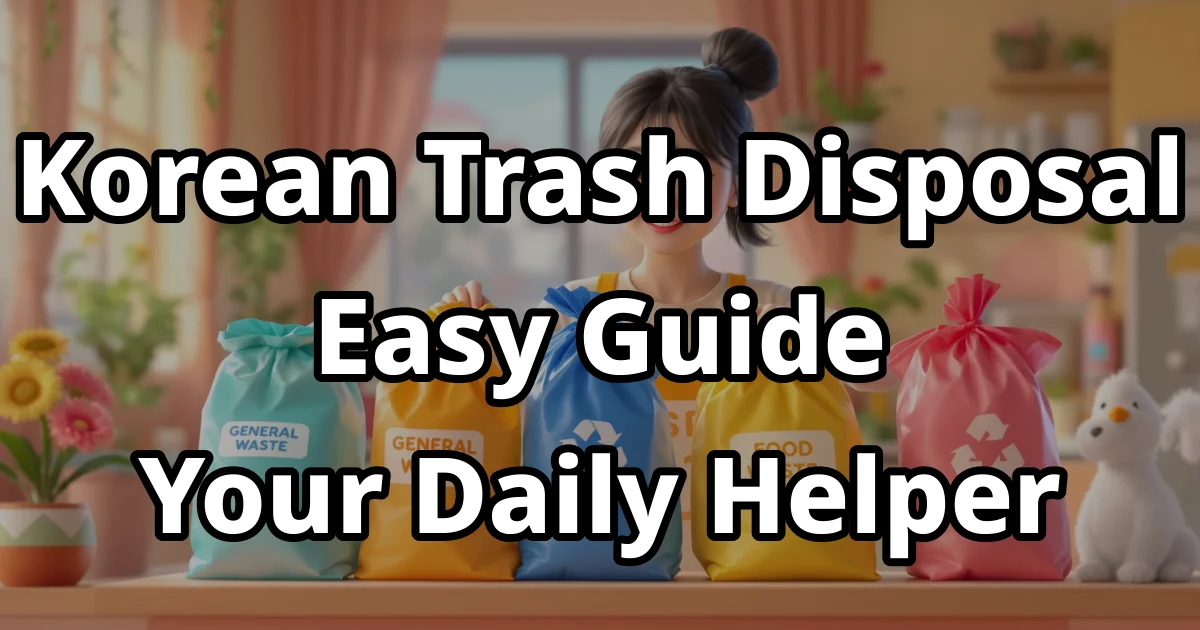
A young Korean woman is carefully separating her trash into different color-coded bags, each clearly labeled for general waste, recyclables, and food waste, with a determined expression, in a vibrant and modern urban apartment. – Disney Pixar style + 3D illustration
VBWF Bag Sizes and Example Costs (Seoul, 2023) 📊
| Bag Size | Approx. Price (KRW) |
|---|---|
| 1L | ~10 |
| 5L | ~30 |
| 10L | ~60 |
| 30L | ~130 |
It’s important to remember that recyclables, food waste, and bulky items are exempt from these bags, as they have their own specific disposal methods. The post-1995 implementation of VBWF was incredibly successful, leading to a 27% drop in waste volume by 2005 and a 67% reduction in landfill use. Public awareness truly surged, even influencing manufacturers to use decomposable bags and reduce packaging! For more details on Gwangjin-gu’s guidelines, you can check their official website.
Different Types of Waste: General, Recyclable, Food, and Bulky
To really master trash disposal in Korea, you need to know the four main categories. This is where most of my initial confusion came from, but once you categorize them, it becomes much simpler. Let’s break them down!
Each type has its own rules, bags, and collection methods. Knowing these distinctions is key to avoiding fines and being a good citizen. Trust me, you don’t want to be *that* neighbor!
Understanding Waste Categories 분류 📝
- General Waste (일반쓰레기): This is your everyday non-recyclable trash – things like tissues, diapers, and non-recyclable plastics. These go into those white or transparent VBWF bags we just talked about.
- Recyclables (재활용): A wide range of items falls here, including paper, PET bottles, cans, and vinyl. These generally go into clear bags and are sorted by material. Think of it as giving your trash a second life!
- Food Waste (음식물쓰레기): This needs to be put in specialized yellow bags or containers. Important note: bones, shells, and large fruit pits are NOT food waste. Make sure to drain all moisture!
- Bulky Waste (대형폐기물): For larger items like furniture, appliances, or even old tires, you’ll need special pre-paid stickers or to register them.
District websites like Gwangjin-gu and Dongdaemun-gu often have specific rules for each category. For instance, in areas like Jangan-dong (장안동), recyclables go into designated bins, and food waste collection typically happens in the evenings, usually Monday to Friday from 6 PM to 10 PM. Always check your local district’s guidelines!
Detailed Recycling Steps and Sorting Guidelines
Recycling in Korea is a serious business, and for good reason! It plays a huge role in their overall waste reduction efforts. So, what do you need to do? The golden rule is cleanliness and proper sorting. If your recyclables are contaminated with food or other waste, they might just end up in the general trash, which defeats the purpose.
I’ve learned that a little extra effort here goes a long way. For example, rinsing out plastic containers or glass bottles might seem tedious, but it’s crucial. Also, always use transparent bags for recyclables—never mix them with general waste bags.
Recycling Checklist: How to Do It Right! ✅
- Clean Everything: Empty out all containers and rinse them thoroughly. This is especially important for food packaging.
- Separate by Type: Paper, plastics (PET, vinyl), metals (cans), glass, and styrofoam all have their own categories. Don’t mix them!
- Prepare Items: Flatten paper, tie it into 30-50cm bundles. Crush cans. For styrofoam, compress or tie it. Remove labels from bottles.
- Use Transparent Bags: Only clear bags are allowed for recyclables so collectors can see the contents.
- Check Local Guidelines: Some districts have specific rules or separate collection bins. When in doubt, there are apps like “내손안의 분리배출 (Nae Son An-ui Bunli Baechool)” which provide real-time, district-specific guides.
It’s amazing how technology helps us recycle better. Apps like “Nae Son An-ui Bunli Baechool” have been downloaded millions of times, making it super easy to check sorting rules on the go. If you ever have a specific question, remember that your local district office (like Gwangjin-gu) often has a hotline to help, for example, Gwangjin-gu’s hotline is 02-450-7622. This comprehensive approach has led to recycling rates of over 70% by the 2020s!
Specialized Handling for Food Waste
Food waste is another category with its own strict rules, and for good reason! Improperly disposed food waste can attract pests and create unpleasant smells, especially in dense urban areas. Just like general waste, you’ll need special bags, usually yellow, in sizes like 1-5L (a 3L bag might cost around 40 KRW).
The most crucial step with food waste is draining all the moisture. This not only reduces the weight (which you pay for!) but also helps in the processing. I always make sure to squeeze out as much liquid as possible before bagging it.
This is a common mistake! Remember that things like bones (chicken, pork, beef), shells (clams, oysters, eggs), fruit pits (large ones like peaches or avocados), tea bags, coffee grounds, and even animal guts or hair are NOT considered food waste. These should go into your general waste bag.
Once collected by dedicated trucks, food waste isn’t just thrown away; it’s processed into animal feed or compost! In fact, about 95% of food waste was recycled in 2023. Facilities like the Busan Environmental Corporation (부산환경공단) use advanced methods like shredding, dehydration, and fermentation to transform it. For most areas, like Gwangjin-gu (you can call them at 02-450-7636 for specific info), food waste is collected in the evenings. Improper disposal can lead to hefty fines, sometimes up to 1M KRW (~840 USD), so it’s definitely worth following the rules!
Disposing of Bulky and Large Items
What about those big items you can’t just fit into a standard trash bag? I’m talking about things like old furniture, tires, or even smaller appliances like irons. These fall under bulky waste and have their own unique disposal protocol.
For most bulky items, you’ll need to purchase a pre-paid sticker. You can usually get these from your local district office or even through specific apps. The fee depends on the item; for example, a sofa might cost around 20,000 KRW, and a TV around 10,000 KRW. Once you have the sticker, you attach it to the item and place it curbside on a scheduled collection day. It’s a system that helps ensure these larger items are disposed of responsibly.
Bulky vs. Large Appliance Disposal 🛋️
| Waste Type | Examples | Disposal Method |
|---|---|---|
| Bulky Waste | Furniture (sofas, desks), small electronics (irons, fans), tires | Purchase pre-paid stickers from district office/app. Place curbside on scheduled day. |
| Large Appliances (>1m) | Refrigerators, washing machines, large TVs, air conditioners | Free pick-up service via hotline (1599-0903) or website (www.15990903.or.kr). Register and keep indoors until pick-up. |
Interestingly, some districts, like Dongdaemun-gu, even list specific small e-waste types (up to 31 different kinds!) that can be disposed of as free bulky waste. You can find out more about this process, including online registration for QR codes or stickers, on sites like Kowork.kr. It’s a great way to ensure these items don’t just end up in a landfill.
Checking District-Specific Schedules and Collection Times
This is perhaps one of the most important, yet often overlooked, aspects of Korean trash disposal: schedules and collection times vary by district, and sometimes even by neighborhood! I’ve seen people get confused because what applies in one part of Seoul might not be true just a few blocks away. It’s not a one-size-fits-all system.
For example, in Gwangjin-gu, specifically in areas like Jungang-dong (중앙동), general waste, food waste, and recycling might be collected on weekday evenings from 6 PM to midnight. Bulky waste usually has a wider window, perhaps Monday to Saturday from 7 AM to 4 PM. However, Dongdaemun-gu might collect general waste in the mornings. It’s truly a local affair!
The absolute best way to stay informed is to check your local district office’s website. They usually have a dedicated “Environment/Cleaning” or “Waste Management” section with detailed calendars. For instance, gwangjin.go.kr provides comprehensive schedules. Remember, there are often no collections on Saturday or holiday evenings!
Falling foul of these rules, like using the wrong bags or putting out trash at the wrong time, can lead to fines. I’ve heard stories, and YouTube guides like “Garbage Guide for South Korea” often emphasize checking with neighbors or local signs to avoid complaints. It’s all about being a considerate part of the community, you know?
Environmental Impact and Future Advancements in Waste Management
The success of South Korea’s waste management system isn’t just about clean streets; it has profound environmental impacts. The VBWF system, coupled with robust recycling efforts, has significantly reduced the burden on incinerators and landfills. I mean, we’re talking about waste volume cut by 95-99% and weight by 80-85% through incineration alone, according to kwaste.or.kr!
Food waste recycling, with its shredders and digesters, is a testament to how seriously they take resource recovery. By 2023, the country was already integrating advanced recycling technologies, including AI sorters, and actively promoting refillable options and minimized packaging. It really feels like they’re always looking for the next best solution.
Key Environmental Benefits & Innovations 🌍
- Reduced Landfill & Incineration: Less waste means less land used and less air pollution.
- High Recycling Rates: Converting waste into new resources, conserving raw materials.
- Energy Recovery: Nearly 99% energy recovery from incinerated waste, contributing to energy needs.
- Technological Integration: AI-powered sorting and advanced processing facilities improve efficiency.
- Circular Economy Focus: Promoting refillables and minimal packaging to reduce waste at the source.
This holistic approach, as highlighted by Atmos Magazine, has made South Korea a model for other nations. Waste per capita has halved since 1995, and their dedication to energy recovery from waste is truly impressive. It just goes to show what a well-thought-out system, combined with public participation, can achieve for our planet!
📚 Related Articles
Well, there you have it! I hope this comprehensive guide has helped you understand South Korea’s unique and efficient trash disposal system a little better. It might seem complicated at first, but with these tips and a little practice, you’ll be sorting and disposing like a local in no time. Remember, adhering to these rules not only keeps your surroundings clean but also contributes to Korea’s remarkable environmental efforts.
If anything is still unclear, or if you have any cool tips to share from your own experiences, feel free to leave a comment below! We can all learn from each other.