

📋 Table of Contents
- 1.My First Invitation to a Korean Wedding: The Meaning of the Envelope
- 2.What is ‘Chug-ui-geum’? The Story Behind Cash Gifts
- 3.The Color and Design of the Envelope: Why White is Standard
- 4.Beyond the Numbers: How Odd/Even and Color Symbols Work Together
- 5.Hanbok’s Red and Blue: The Balance of Eum-Yang (Yin-Yang)
- 6.Colors and Symbols in Traditional Ceremonies: An Extension of Envelope Culture
- 7.The Envelope System in Modern Wedding Halls: Reception, Guestbook, and Buffet
- 8.The Social Distance in an Envelope: What Money, Color, and Name Reveal
I remember my first time being invited to a Korean wedding. It was super exciting, but also a little nerve-wracking because I wasn’t sure about all the customs. What do I wear? How long does it last? And, you know, what’s with the envelope everyone talks about?
Korean weddings have their own unique charm, often moving at a much faster pace than what many of us might be used to. But one thing that always stands out, and often creates a bit of confusion for first-timers, is the envelope culture.
Unlike Western weddings where a gift registry is common, in Korea, cash gifts are almost the universal standard. This little envelope holds a lot more meaning than just money; it’s a key that unlocks the entire wedding experience, from greeting the couple to enjoying the meal. Let’s dive into why this humble envelope, especially its color, is so important!
My First Invitation to a Korean Wedding: The Meaning of the Envelope
Getting an invitation to a Korean wedding is a special moment! But if it’s your first time, you might notice some things are a bit different from what you expect. For starters, Korean weddings are often quite efficient, typically lasting about 1 to 1.5 hours in total, from the ceremony to the meal.
When you arrive at a Korean wedding hall (웨딩홀, wedinghol), the very first thing you’ll usually encounter is the ‘chug-ui-geum’ (축의금) reception desk. This is where guests present their cash gifts in an envelope. It really sets the tone for the entire event, as this act is your initial interaction and often determines your access to the meal!
Interestingly, the wedding ceremony itself doesn’t typically hold legal weight in Korea. Many couples actually complete their official marriage registration (혼인신고, honinsingo) before the ceremony. This fact helps us understand why the custom of giving cash in an envelope functions less as a gift for starting a new home and more as a social obligation and a respectful gesture within a communal network.
Key Differences in Korean Wedding Culture 📝
- Duration: Often shorter, around 1 to 1.5 hours.
- Gift Type: Cash (chug-ui-geum) is the primary form of gift.
- Legal Status: Marriage registration usually precedes the ceremony.
- First Interaction: Presenting your envelope at the reception desk.
What is ‘Chug-ui-geum’? The Story Behind Cash Gifts
So, what exactly is ‘Chug-ui-geum’ (祝儀金, chug ui-geum)? Simply put, it’s a monetary gift given to celebrate a wedding. This tradition isn’t just about giving money; it’s a fundamental part of a broader social network in Korea where adults exchange financial support during major life events like weddings and funerals. It’s a system of mutual aid that keeps communities connected and supported.
You might wonder why cash became the standard instead of physical gifts, especially when many Western cultures use gift registries. Well, Korea’s unique social structure, with often smaller living spaces, makes practical considerations important. Cash offers flexibility and immediate usefulness to the newlyweds, allowing them to purchase what they truly need rather than accumulating duplicate gifts or items they don’t have space for. This practicality, combined with a long-standing tradition of reciprocal giving, cemented cash as the preferred gift. For more details on Korean wedding traditions, you can check out this guide on The Knot.
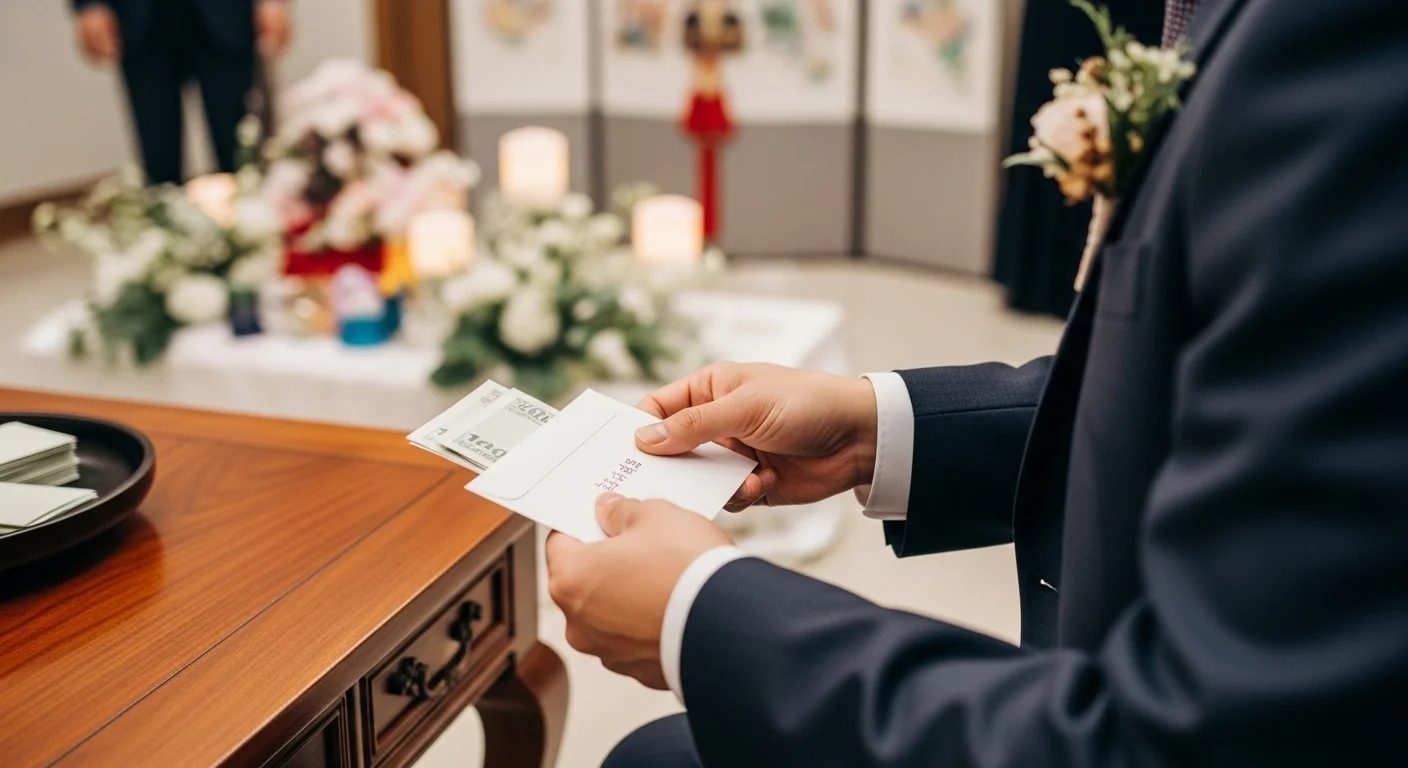
A Korean person is subtly placing a crisp white envelope, containing money, onto a traditional wooden reception table at a modern Korean wedding hall.
The amount is typically given in odd-numbered increments of 10,000 Korean Won (KRW). For example, 50,000 KRW or 70,000 KRW are common. This isn’t just a random choice; it’s tied to deeper cultural symbolism we’ll explore later. Also, think of chug-ui-geum as a social investment; the expectation is that the favor will be returned, usually in a similar amount, when the giver has their own wedding or major family event.
The Color and Design of the Envelope: Why White is Standard
When it comes to the envelope for your chug-ui-geum, you’ll quickly notice a prevalent trend: most are white. In fact, many wedding halls will even provide plain white envelopes at the reception desk, making it super convenient. This isn’t just a random aesthetic choice; it’s deeply rooted in Korean cultural practices.
White is considered a neutral and unbiased color, making it suitable for all kinds of ceremonial occasions, not just weddings. Traditionally, white has symbolized cleanliness, purity, and formality, often used for important public documents or monetary envelopes. You can read more about various customs in this article on Korean Wedding Traditions.
Why White Envelopes? 📝
- Neutrality: It’s a universally accepted color for all types of formal occasions in Korea, not just weddings.
- Symbolism: Represents purity, cleanliness, and new beginnings, which align perfectly with a wedding.
- Practicality: Wedding halls often provide them, streamlining the process for both guests and staff.
- Tradition: Historically used for official documents and monetary gifts, lending a sense of formality.
While you might see colorful envelopes (red, blue, gold) sold for celebratory purposes in stores, they are generally not used at actual Korean wedding halls. They can stand out too much and might even cause practical issues for staff who are typically set up to process standard white envelopes for recording and accounting. Moreover, using a dark or black envelope is a big no-no, as those colors are specifically associated with funerals (부의금, bu-ui-geum) and could lead to serious misunderstanding.
Beyond the Numbers: How Odd/Even and Color Symbols Work Together
As I mentioned earlier, the specific amount of money you put into the envelope also carries symbolic weight, particularly the preference for odd numbers. This tradition extends beyond just monetary value; it’s intertwined with a broader East Asian belief system where even numbers can symbolize “splitting” or “dividing,” while odd numbers signify continuity and an unbroken bond.
So, when you combine the standard white envelope with an odd-numbered cash gift (like 50,000 KRW or 70,000 KRW), you’re sending a subtle but clear message of sincerity and well wishes for a lasting, harmonious marriage. It’s an unspoken code that communicates your thoughtfulness and respect for the customs. You can discover more about these stunning traditions in South Korea on TLC’s Weddings section.
| Number Type | Symbolic Meaning | Examples for Chug-ui-geum |
|---|---|---|
| Odd Numbers | Continuity, completeness, unbroken bond | 50,000 KRW, 70,000 KRW, 150,000 KRW |
| Even Numbers | Splitting, division (generally avoided for celebratory gifts) | 20,000 KRW, 40,000 KRW (except for 100,000 KRW which is widely accepted) |
Typical amounts for acquaintances range from 50,000 KRW to 100,000 KRW, while closer friends and family might give 100,000 KRW to 200,000 KRW or more. Within these ranges, the preference for white envelopes and odd numbers remains strong. A white envelope containing an unusually low or high amount, or an even number, can sometimes be interpreted as a message about the giver’s etiquette or the intimacy of their relationship with the couple.
Hanbok’s Red and Blue: The Balance of Eum-Yang (Yin-Yang)
To understand why colors carry such weight in Korean wedding culture, we should look at the traditional attire: the Hanbok (한복). In traditional Korean weddings, the bride typically wears a red-toned Hanbok, while the groom wears a blue-toned one. This isn’t just for beauty; it symbolizes the harmony of Eum-Yang (陰陽, Yin-Yang), a fundamental concept in East Asian philosophy.
Red represents Yang (양) – passion, vitality, and light – while blue represents Eum (음) – stability, healing, and darkness. When these two colors come together, they create a perfect balance, much like the Taegeuk (태극) symbol found on the Korean national flag. This symbolism extends to the parents’ Hanboks as well: the groom’s mother often wears a light blue or green Hanbok, and the bride’s mother typically wears a pink or purple one, clearly distinguishing the families.
The concept of Eum-Yang is all about balance and harmony. In a wedding, it represents the coming together of two individuals to create a complete and balanced union. This deep-rooted cultural belief in color symbolism provides the foundation for why even the color of a small envelope can convey significant meaning.
Colors and Symbols in Traditional Ceremonies: An Extension of Envelope Culture
The use of color and symbolism is deeply woven into traditional Korean wedding ceremonies, showing us just how much meaning these visual cues carry. Let’s look at a few examples to see how this plays out, extending even to the subtle choice of your envelope’s color.
Traditional Wedding Rituals & Symbolism 📝
- Jeon-an rye (전안례): The groom presents a wooden goose (원앙 세트, won-ang seteu) to the bride’s family. Geese mate for life, symbolizing lifelong fidelity and responsibility within the marriage.
- Hap-geun-rye (합근례): The bride and groom share ceremonial wine (정종, jung jong) from separate cups, then mix and drink from a combined cup. This ritual signifies the intertwining of their lives and destinies, a profound marital vow.
- Pyebaek (폐백): The couple bows to their parents, who then throw dates (대추, daechu) and chestnuts (밤, bam) onto a cloth held by the couple. Dates symbolize sons, and chestnuts symbolize daughters, with the number caught representing wishes for many children. The red of the dates and the dark hue of the chestnuts are key visual elements here.
In all these rituals, colors—from the red dates and dark chestnuts to the vibrant Hanboks—act as symbolic messengers. This ingrained understanding that “color equals meaning” has naturally carried over into modern practices, creating an atmosphere where even the color of a chug-ui-geum envelope isn’t taken lightly. These traditions truly highlight the depth of Korean cultural expression. For more insights into Korean wedding traditions, you can explore Orange Blossom Special Events.
The Envelope System in Modern Wedding Halls: Reception, Guestbook, and Buffet
Let’s talk about the practical side of things in a modern Korean wedding hall. The whole process is quite streamlined, and the envelope plays a very functional role. From the moment you step in, here’s what you can generally expect to happen:
Modern Wedding Hall Process 📝
- Chug-ui-geum Reception: At the entrance, you’ll find a reception desk. This is where you hand over your chug-ui-geum envelope, often provided in white, and sign the guestbook (방명록, bangmyeongrok) with your name and amount.
- Bride’s Waiting Room: Next, you might head to the bride’s waiting room (신부대기실, sinbudaegisil) to take photos with the bride before the ceremony.
- The Ceremony: The wedding ceremony itself is usually short, lasting about 30 minutes, featuring an MC, officiant or congratulatory speech, the couple’s vows, and their grand entrance/exit.
- Meal Time: Afterward, guests proceed to the dining area for a buffet or course meal. The entire event typically wraps up in about 1 to 1.5 hours.
During this fast-paced process, your envelope serves multiple purposes. It acts as a record of your attendance, often functioning as a meal ticket, and helps the families keep track of their social network and financial exchanges. Because white envelopes are generally provided by the wedding hall and are part of this efficient system, bringing your own brightly colored envelope (like red or gold) can actually be quite unusual and might even cause a slight hiccup in the smooth flow of operations.
This is why the question “Why does the envelope color matter?” often boils down to a simple, unspoken rule: stick to white as the standard, and absolutely avoid black or dark colors (which are for funerals). Your choice of envelope becomes a quiet signal of your understanding of and respect for Korean customs, reflecting your role and relationship within this social fabric.
The Social Distance in an Envelope: What Money, Color, and Name Reveal
It might seem like a small detail, but the information on your chug-ui-geum envelope—its color, the name on the outside (your personal name or family name), and the amount inside—all combine to communicate a subtle message. This message tells the couple and their families a lot about how close you are to them and the sincerity of your well-wishes.
From a guest’s perspective, choosing the wrong envelope color can lead to misunderstandings. For instance, using an overly dark envelope might inadvertently evoke the somber mood of a funeral. Similarly, a very bright or unusually designed envelope could draw unwanted attention and signal that you’re unfamiliar with local customs, potentially causing inconvenience for the wedding staff who are used to processing standard white envelopes.
Using a dark-colored envelope (especially black) for a wedding can be misinterpreted as a gift for a funeral (부의금, bu-ui-geum). Always opt for a white envelope to avoid any cultural misunderstandings.
Conversely, presenting a clean white envelope with an appropriate amount (typically between 50,000 KRW and 200,000 KRW, depending on your relationship) and a neatly written name is seen as fulfilling your ceremonial responsibilities in Korean society. This act also plays into the cyclical nature of giving and receiving; that amount is likely to be reciprocated when the other party attends your future wedding or family event. So, for those experiencing a Korean wedding for the first time, selecting the correct envelope is more than just a matter of taste; it’s your very first step into understanding and participating in Korea’s intricate social network and ceremonial etiquette. It really connects back to why we started this conversation: why the envelope color truly matters.
Key Aspects of Korean Wedding Etiquette
📚 Recommended Reading
Frequently Asked Questions ❓
Attending a Korean wedding is a truly memorable experience, and I hope this guide helps you feel more prepared and confident. Understanding the nuances of chug-ui-geum and the significance of the envelope color isn’t just about following rules; it’s about showing respect for a rich culture and connecting with people on a deeper level. These seemingly small details carry a lot of meaning and contribute to a beautiful tradition. If you have any more questions or want to share your own experiences, please feel free to leave a comment below!