
📋 Table of Contents
- 1.The “Less Spicy” Misunderstanding in Korea
- 2.Beyond the Burn: Understanding Korean Spicy Food
- 3.Decoding “Mild”: Why Your Order Stays Hot
- 4.The Secret Ingredient: “Siwonhan-mat” and Its Fiery Role
- 5.Navigating Spice Levels: When “Level 1” Is Still a Challenge
- 6.Dispelling Myths: What Koreans Really Eat Daily
Have you ever visited Korea, ordered something “less spicy,” and still ended up with tears in your eyes and sweat on your brow? I know I have! It’s a super common experience for many visitors, and honestly, it can be a bit confusing at first. You might think you’re getting a gentle kick, but then BAM! — you’re suddenly in a spicy food challenge. Let’s dive into why ordering less spicy in Korea can often feel like a mistake and how you can truly enjoy the amazing flavors without the overwhelming heat.
The “Less Spicy” Misunderstanding in Korea
When you ask for “less spicy” in a Korean restaurant, you’re hoping for a gentle version of the dish, right? But here’s the thing: what Koreans consider “less spicy” is often still quite hot by international standards. It’s not just about turning down the heat; spiciness in Korea is a whole cultural experience!
For many Koreans, spicy food isn’t just a simple flavor. It’s tied to stress relief, that “siwonhan-mat” (refreshing taste) you get from a hot, spicy broth, and even the feeling of sweating it out. Because of this, even if you’re a foreigner, restaurant chefs might not drastically reduce the chili powder or gochujang (Korean chili paste) from their original recipes. They’re aiming for a Korean-approved “mild,” which, let’s be honest, is usually still pretty spicy!
Common Scenario 📝
- You ask for “less spicy” in English or Korean.
- The staff assures you it will be mild.
- Your dish arrives, and after the first bite, you’re reaching for water, tissues, and probably wondering what just happened!
This isn’t a new phenomenon. Since the 2020s, YouTube and TikTok have been flooded with videos titled “Korean ‘mild’ is not mild,” showing countless foreigners hilariously struggling with their “less spicy” Korean meals. It’s a rite of passage, almost!
Beyond the Burn: Understanding Korean Spicy Food
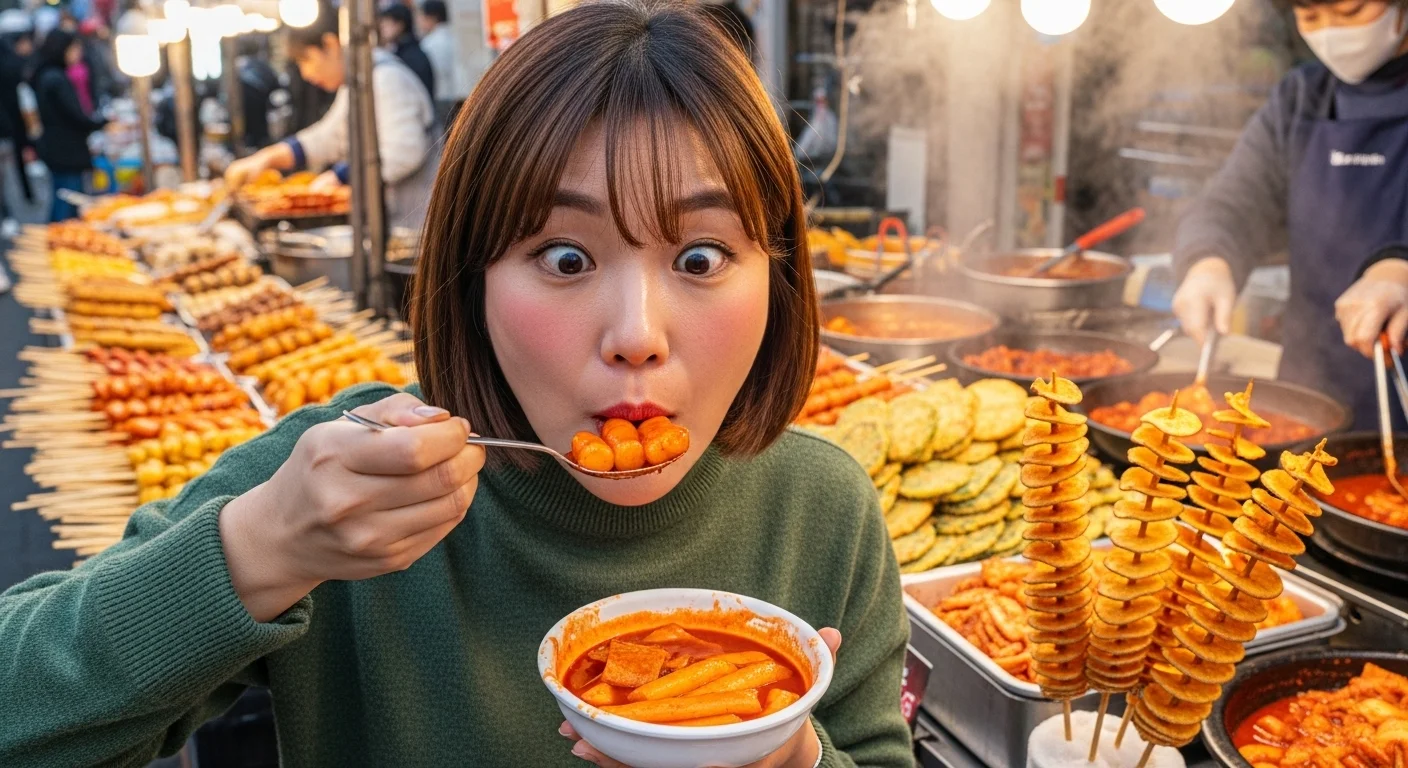
A tourist surprised by the spiciness of tteokbokki at a street food market.
So, why is Korean food so famous for its heat? Well, while Korean chili peppers (like green and red chilies) generally have a Scoville Heat Unit (SHU) of 2,500 or less, which is actually lower than a jalapeño, it’s how they’re used that makes all the difference. Koreans are masters of layering spiciness!
They use chili powder, fresh Cheongyang chili peppers (up to 10,000 SHU!), gochujang, and chili oil, often all in one dish. This multi-layered approach means the capsaicin builds up, creating a much stronger perceived heat. It’s like a spicy flavor bomb!
Popular Spicy Korean Dishes 📝
- Tteokbokki: Sticky rice cakes in a sweet and spicy gochujang-based sauce. Even the “mild” version can be quite fiery for beginners.
- Kimchi Jjigae/Budae Jjigae: Stews featuring fermented kimchi, chili powder, and gochujang. Often eaten with rice, which helps a bit!
- Buldak (Fire Chicken): Chicken marinated in an extremely spicy sauce, then grilled or stir-fried. The instant ramen version, Buldakbokkeummyun, is infamous worldwide!
- Nakji-bokkeum/Jjukkumi-bokkeum: Stir-fried octopus or webfoot octopus, loaded with Cheongyang chili and chili powder. The oily sauce makes the heat linger!
So, when you order a “regular” or even “less spicy” version of these dishes, you’re already starting at a higher spice level than you might expect from other cuisines. For more insights, you can check out this guide on How spicy is Korean food? from Kelly Loves, a UK-based Korean food brand.
Decoding “Mild”: Why Your Order Stays Hot
It’s a common dilemma: you clearly say “not spicy” or “less spicy,” but your meal still packs a punch. Why does this happen? It largely comes down to cultural and linguistic differences.
First, there’s the flavor balance. Restaurant owners are very proud of their recipes. If they drastically cut down on chili, they feel like the whole taste profile—the sweet, salty, umami notes—will be ruined. So, instead of making a truly non-spicy version, they might just reduce the chili by 20-30%, not enough for those unaccustomed to the heat.
Many Koreans regularly eat fresh Cheongyang peppers, which are quite hot. So, their baseline for “spicy” is much higher than in many other countries. What’s “a little spicy” to them might be “very spicy” to you!
Another factor is Korean etiquette. If you say “조금만 덜 맵게 해주세요” (jo-geum-man deol maep-ge hae ju-se-yo), which means “please make it a little less spicy,” it might be interpreted as a polite suggestion rather than a strong request. The kitchen, fearing they’ll ruin the dish, might only make a small adjustment.
And here’s a funny, but true, story: many foreign visitors boast “I like spicy food!” only to be served something incredibly hot, a “challenge level” of spiciness by Korean standards. Always be clear and specific about your spice tolerance!
The Secret Ingredient: “Siwonhan-mat” and Its Fiery Role
There’s a unique Korean taste concept called “siwonhan-mat” (시원한 맛), which translates roughly to “refreshing taste.” It’s not just about the flavors on your tongue, but the whole experience of a hot, spicy broth warming your body, clearing your sinuses, and providing a sense of relief, especially for hangovers or colds. It’s like a satisfying, invigorating feeling!
VICE even discussed a “Korean spicy food taxonomy” in 2019, dividing Korean spicy dishes into two main types:
Korean Spicy Food Types 📝
- Masit-neun (spicy but delicious): This type features the savory depth of gochujang, rich broth, and a balance of sweet and salty. It’s the kind of spicy that makes you say, “I can’t stop eating this, even though it’s so hot!”
- Siwonhan (spicy but refreshing): Think Yukgaejang (spicy beef soup), Kimchi Jjigae, or Haejangguk (hangover soup). These are hot, often spicy, broths that are believed to warm your body and are good for colds or fatigue.
The catch? To achieve that “siwonhan-mat,” Koreans often believe a certain level of spiciness is essential. So, if you order a “less spicy soup,” the chef might still keep a good amount of chili to ensure it still has that refreshing, body-warming kick. The phrase “the soup is refreshing” often implies it’s also quite spicy!
This cultural connection between spiciness and a healthy, invigorating feeling creates a big gap between what a foreigner expects as “not spicy at all” and what’s actually served as “less spicy.” Understanding this can really help manage your expectations! For more on this, check out the VICE article on Korean spicy food taxonomy.
Navigating Spice Levels: When “Level 1” Is Still a Challenge
Many Korean restaurants and franchises now offer “Spice Level 1-5” options, especially in tourist areas. You might see guides like Creatrip’s “Spicy Korean Food 5 Level Test” that break down the levels.
Typical Korean Spice Levels 📝
| Level | Description | Examples |
|---|---|---|
| 1 (Mild) | Slightly spicy | Kimchi, mild kimchi jjigae, mild tteokbokki |
| 2 (Normal) | Regular spicy | Standard tteokbokki, regular ramen |
| 3 (Spicy) | Very spicy | Spicy chicken, jjukkumi-bokkeum |
| 4-5 (Extreme) | Challenge level | Buldak, “nuclear fire” level dishes |
The big issue? Even Level 1 can be a significant challenge for someone from a country where chili isn’t a regular part of the diet. While Korean chili powder itself might be milder, the sheer quantity and the layered use of various chili products amplify the heat dramatically.
Plus, many restaurants only describe these levels in Korean, or use vague terms like “Level 1: a little spicy.” If you interpret “a little spicy” as “mild,” you’re in for a surprise! Dishes like Buldak and “Haek Buldak” (nuclear fire chicken) are seen as a “game” even among Koreans, yet some foreigners are directed to these levels because they said “I want to try Korean spicy food!”
Dispelling Myths: What Koreans Really Eat Daily
One of the biggest misconceptions I’ve seen is thinking, “Oh, this must be normal if Koreans eat it.” There’s a famous YouTube clip, “When ordering food in Korean goes horribly wrong,” that perfectly illustrates this.
When a Korean says “it’s not very spicy,” they usually mean “an adult Korean can eat this without much trouble.” For someone from a non-chili-eating culture, that same level of heat can be an extreme challenge!
It’s also easy to assume that a Korean person recommending a dish means it’s an everyday, standard level of spice for them. But sometimes, if you mention you like spicy food, they might, out of a sense of fun or challenge, recommend something much hotter. Dishes like Buldak, Nakji-bokkeum, or super spicy chicken aren’t necessarily everyday meals for all Koreans; they’re often sought out when they’re actively craving something very hot.
So, don’t feel bad if you struggle with “less spicy” dishes. It’s a common experience, and it just highlights the unique and intense relationship Koreans have with their beloved chili! For a general guide on how to approach these levels, Creatrip offers a Spicy Korean Food 5 Level Test that might help you assess your own tolerance.
Key Takeaways: Korean Spice
📚 Related Articles
Frequently Asked Questions ❓
It’s clear that the Korean approach to spiciness is a unique blend of culinary tradition and cultural experience. So, the next time you’re in Korea and craving something delicious, remember these tips about “less spicy” orders. Don’t be afraid to ask questions or even try some of the fantastic non-spicy options available! I hope this helps you enjoy your Korean food adventures even more. If you have any more questions or want to share your own spicy food experiences, feel free to leave a comment below!