
📋 Table of Contents
- 1.Early Morning Delivery in Seoul: A First Look at a Dazzling Speed
- 2.What Exactly is Seoul’s “Early Morning Delivery”?
- 3.How is Such Speed Even Possible? The Tech Behind the Scenes
- 4.Whose “Early Morning” Is It? The Human Cost of Speed
- 5.When Even the CEO Joined the Front Lines: Coupang’s Experience
- 6.“Fast Seoul” Through a Consumer’s Eyes: Convenience and Lifestyle Changes
Imagine this: you order something late at night, expecting it in a few days, maybe longer if it’s the weekend. That’s what I thought was normal, you know? But then I came to Seoul, and everything changed. My first experience with “Early Morning Delivery” was, well, a complete shock!
I mean, honestly, is Seoul really that fast? People here can order fresh abalone at 10:59 PM and have it at their door by 7 AM the next day. It makes you wonder, doesn’t it? This isn’t just a simple delivery; it’s a whole new level of speed and precision that makes you ask: How is this even possible? Let’s dive in and find out what makes Seoul’s mornings so incredibly fast.
Key Takeaways: Seoul’s Early Morning Delivery
Early Morning Delivery in Seoul: A First Look at a Dazzling Speed
When I first arrived in Seoul, I was genuinely amazed by how fast everything moved. But nothing quite prepared me for the magic of “Early Morning Delivery”. It’s a service where you order groceries or other goods late at night, and they magically appear at your doorstep by 7 AM the next day. Sometimes even earlier!
This concept really took off between 2016 and 2018, pioneered by services like Market Kurly’s ‘Saetbyeol Delivery’ (샛별배송) and Coupang’s ‘Rocket Fresh’ (로켓프레시). For someone used to waiting 3-4 days, or even longer with weekend delays, this speed felt almost futuristic. I remember thinking, “Do things really need to be this fast?”
The Basics of Early Morning Delivery 📝
- Concept: Order at night, receive by 7-9 AM the next day.
- Origin: Expanded after Coupang’s ‘Rocket Delivery’ in 2015, with Market Kurly popularizing the ‘Early Morning Delivery’ category.
- Example: “Abalone ordered at 10:59 PM arrives by 7 AM.” This kind of speed is regularly featured in Korean news.
My first time trying it, I was working late, too tired to go grocery shopping. I opened an app, ordered some basics, and by morning, there it was – a box waiting quietly outside my door. It was incredibly convenient, but a part of me couldn’t help but feel a little uneasy about such rapid service. Could this really be sustainable?
What Exactly is Seoul’s “Early Morning Delivery”?
Let’s clear up some terms because Korea has several speedy delivery options. Early Morning Delivery, as we’re discussing, is when you order at night and your items arrive by around 7 AM the next day. It’s mainly for fresh foods.
Then there’s Same-Day Delivery or “Quick Commerce,” where you get your items within a few hours on the same day. Regular parcel delivery, like in many other countries, usually takes a day or two and happens during business hours. Seoul’s Early Morning Delivery is a special category all its own.

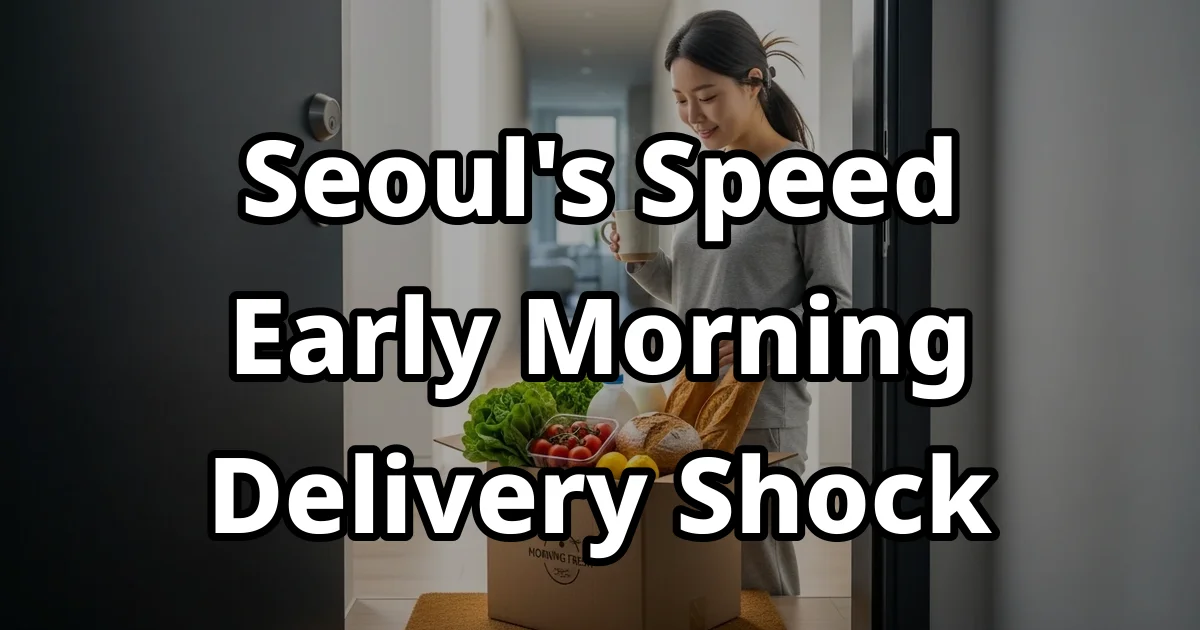
A Korean woman is looking at fresh groceries delivered to her doorstep in the early morning in a modern apartment building. – high-quality realistic photography
Understanding Delivery Times ⏰
| Delivery Type | Order Time | Arrival Time | Key Feature |
|---|---|---|---|
| Early Morning Delivery | Night before (e.g., by 11 PM) | Next day by 7 AM | Fresh & refrigerated foods |
| Same-Day Delivery | Morning/Afternoon | Same day (within hours) | Urgent needs, various items |
| General Parcel Delivery | Anytime | 1-2+ days, daytime | Standard shipping for most goods |
Most of these services, like Market Kurly’s Saetbyeol Delivery or Coupang’s Rocket Fresh, promise delivery by 7 AM if you order by their cutoff time (usually 11 PM to midnight). However, there’s a catch: Early Morning Delivery is mostly limited to the Seoul Metropolitan Area (Seoul, Gyeonggi, Incheon). This is because the huge fulfillment centers, where all the magic happens, are concentrated around these areas. If you live outside, you might not get this service.
What kinds of things get delivered? Think fresh and ready-to-eat: dairy, eggs, meat, fish, salads, meal kits, baby formula, and even premium organic fruits. My first order, placed at 10:30 PM, included eggs, milk, salad, fruit, and coffee. The app said “by 7 AM tomorrow,” and sure enough, a box was at my door at 6:20 AM, packed with ice packs and dry ice to keep everything fresh. It was a contactless delivery, left right at my door. Pretty neat, right? You can compare Early Morning Delivery services for more details.
How is Such Speed Even Possible? The Tech Behind the Scenes
So, how do they do it? It’s not magic, but it sure feels like it! The secret lies in something called “Data-driven decision making.” Companies like Coupang and Market Kurly use tons of accumulated data, just like Amazon does, to figure out exactly what customers will order and when.
Imagine an AI predicting that on a Friday night, everyone will want steak and beer snacks, or that on Monday morning, salads will be a hit. That’s what happens! Based on these predictions, they place orders with producers in advance. This “predictive ordering” means items are already at the fulfillment centers, ready to go, even before you click “order.”
AI analyzes past orders to predict future demand, ensuring products are stocked and ready before customers even realize they need them.
These giant fulfillment centers, mostly in the Seoul metropolitan area, are amazing places. They’re designed with special sections for refrigerated, frozen, and room-temperature items. They even use a “cold chain” system to keep fresh food perfectly chilled from the moment it arrives at the center until it reaches your door. This is super important for things like milk and fresh meat!
And here’s another cool part: once your order is placed, an algorithm calculates the shortest delivery route. It considers all the orders, addresses, and promised arrival times, then figures out the most efficient path for each delivery truck. Each truck might have 100-200 orders, all optimized to be delivered within 6-7 hours. This entire process is why Early Morning Delivery has to happen so early – less traffic means faster driving, and contactless delivery means no waiting for customers to answer the door. It’s a marvel of technology and human coordination!
Whose “Early Morning” Is It? The Human Cost of Speed
While we enjoy the incredible convenience of Early Morning Delivery, it’s important to remember that this speed comes at a cost. Behind every perfectly chilled box delivered before dawn are the taxi drivers, Coupang Friends (쿠팡친구), and logistics center workers who work through the night. Their labor conditions and health have become a serious concern, highlighted by various media reports and government studies.
A study commissioned by the Ministry of Employment and Labor compared the heart rates and blood pressure of night-time delivery drivers with daytime drivers. The results were worrying: night-time drivers showed a higher risk of cardiovascular diseases like heart attacks. This is often linked to irregular sleep patterns and demanding schedules. Some Coupang drivers, for example, were found to be working 1.5 to 2 times the legally allowed maximum working hours, combining both night and day shifts. You can read more about this in a report from Hankyoreh21.
Night-time delivery workers face increased health risks, including higher chances of cardiovascular diseases, due to extended hours and disrupted sleep cycles.
The situation is grim. According to reports from the Korean Confederation of Trade Unions’ Parcel Delivery Workers’ Union and other media, 29 Coupang workers have died since 2020. In 2025 alone, 8 Coupang workers (4 delivery drivers, 4 logistics center workers) reportedly passed away. These statistics paint a stark picture of the challenges faced by those who make Early Morning Delivery possible.
Their workday often starts in the evening or at night with loading and sorting, then shifts to delivery from midnight until morning. Many endure “10-hour full-course” shifts. When I first saw that box outside my door, I only thought about the convenience. But now, I realize that Seoul’s incredible speed is truly thanks to the “people who break the night” to make it happen. It’s a sobering thought that makes you appreciate the service, but also question its human cost.
When Even the CEO Joined the Front Lines: Coupang’s Experience
The intense working conditions of Early Morning Delivery workers haven’t gone unnoticed. In fact, it became such a public issue that in March 2026, Coupang’s CEO, Harold Rogers, decided to experience it firsthand. He spent about 10 hours, from 8:30 PM on March 19th to 6:30 AM the next day, delivering packages in Seongnam, Gyeonggi Province. During this time, he handled nearly 200 items for about 130 households. What a day, right?
Interestingly, this wasn’t his first time. He had also secretly visited a delivery camp in Songpa-gu, Seoul, a week earlier on March 12th, to experience night delivery alone. Coupang explained that these visits were “to inspect the delivery sites and encourage the efforts of field staff” before a planned joint experience with members of the Democratic Party of Korea, including lawmaker Yeom Tae-young. You can read more details about his experience in this DongA Ilbo article.
CEO’s Delivery Challenge 🚚
- Who: Coupang CEO Harold Rogers.
- When: March 19-20, 2026 (approx. 10 hours).
- Where: Seongnam, Gyeonggi Province.
- What: Delivered ~200 items to ~130 households, experiencing the full night shift.
- Purpose: Officially, to understand field conditions; unofficially, to address public concerns about labor.
The public’s reaction was mixed. Some called it “protocol delivery,” a mere PR stunt for political purposes. Others argued that it was still significant for a top executive to personally experience a 10-hour night shift. From my perspective, one day of experience is vastly different from working hundreds of days a year. However, it was a symbolic moment that showed politicians and the public were starting to pay attention to the demanding working conditions of Early Morning Delivery. It sparked an important discussion, as detailed in this Kookmin Ilbo article.
“Fast Seoul” Through a Consumer’s Eyes: Convenience and Lifestyle Changes
From a consumer’s point of view, Seoul’s Early Morning Delivery is incredibly transformative. It’s changed how I and many others manage daily life. No more rushing to the supermarket after a late night at work! Now, you can simply order your groceries from your phone and wake up to fresh ingredients ready for breakfast or packing your lunch.
This service has made a “just-in-time” lifestyle possible for many. You don’t need to stock your fridge to the brim; you can just order what you need, when you need it. It’s like having a magical, always-open grocery store right at your fingertips. This level of convenience impacts everything from meal planning to reducing food waste, making city living feel a lot smoother. It’s truly a game-changer for urban dwellers who are always on the go.
📚 Recommended Articles
So, is Seoul really that fast? Yes, it absolutely is! My first experience with Early Morning Delivery completely opened my eyes to a new level of convenience. It’s a testament to incredible technology and logistics, but it also prompts us to consider the human effort and cost behind such speed. It’s a fascinating blend of modern living and ethical questions. If you have any questions or your own experiences with Early Morning Delivery, feel free to share them in the comments below!