

📋 Table of Contents
- 1.Beyond Seaweed: What Koreans Really Gift
- 2.Choosing Wisely: Gifts for Every Relationship
- 3.Elegant Fabric: Hanbok Pouches and Bojagi
- 4.Small Treasures: Traditional Design Goods
- 5.Home Comforts: Korean Tableware and Living Items
- 6.A Taste of Tradition: Korean Alcohol Gifts
- 7.Gifts with a Story: Symbolic Korean Items
Hey there! Have you ever found yourself in Korea, wanting to buy a special gift, but feeling stuck with just seaweed or basic chocolates? I totally get it. It’s easy to just grab the most common souvenirs, but what if you want to give something that truly shows thoughtfulness and a deeper understanding of Korean culture?
Well, you’re in luck! Korean locals actually put a lot of thought into their gifts, especially when it comes to showing appreciation to friends, business partners, or hosts. With the global popularity of K-Drama, K-Pop, and K-Beauty, there’s a growing desire to find gifts that are both distinctly Korean and practical for everyday use. It’s not just about what looks Korean, but what genuinely reflects the country’s charm.
From bustling traditional markets like Insadong (인사동) and Samcheongdong (삼청동) to modern K-Heritage stores and department store pop-ups, the options for unique Korean gifts are endless. This means you can find something perfectly tailored to anyone’s taste and your relationship with them. Let’s dive into some amazing gift ideas that Koreans themselves actually give, complete with their symbolism, price ranges, and where to find them. You’ll be a gift-giving pro in no time!
Key Takeaways: Unique Korean Gifts
Beyond Seaweed: What Koreans Really Gift
You know, when foreigners visit Korea, the number one souvenir is still often seaweed. But what about the gifts that Koreans themselves give to show genuine care and thoughtfulness? It’s a whole different ball game! Since the 2020s, with the huge global wave of K-Drama, K-Pop, and K-Beauty, gifts have also evolved. Now, people look for items that show a clear Korean identity while also being practical for everyday life.
I’ve noticed that shopping for these kinds of gifts has become so much easier these days. You can find amazing things at places like the K-Heritage Store online, traditional areas like Insadong (인사동) and Samcheongdong (삼청동), or even beauty stores like Olive Young and department store pop-ups. This variety means you can pick out gifts that truly match someone’s taste and your relationship with them, which is really cool.
Why Locals Look Beyond Common Souvenirs 📝
- Desire for Authenticity: Locals want to give gifts that reflect genuine Korean culture, not just tourist clichés.
- Practicality and Longevity: Gifts that can be used daily and last a long time are highly valued.
- K-Culture Connection: Items that subtly connect to the global K-wave (drama, music, beauty) resonate well.
- Personalized Gifting: The ability to choose gifts based on the recipient’s taste and the relationship is key.
In this guide, I’ll walk you through five fantastic Korean gift categories that move beyond the usual seaweed or chocolates. These are the kinds of unique Korean gifts locals actually give to their friends, business associates, or honored guests. We’ll cover everything from their cultural significance to price points and where to buy them. Let’s get started!
Choosing Wisely: Gifts for Every Relationship
When it comes to gifting in Korea, the first thing locals consider is “Who is this for?” It really makes a difference whether you’re buying for a foreign friend, a business client, a professor, an elder, or a host family. The formality and budget of the gift will change dramatically depending on your relationship.
For instance, if you’re thinking about a foreign friend or an exchange student, you’d probably go for something light, fun, and distinctly Korean in design, like mother-of-pearl (Jage, 자개) stickers, Hanbok (한복) themed soap, or a bundle of Korean snacks and tea bags. These are usually on the more casual and playful side, you know?
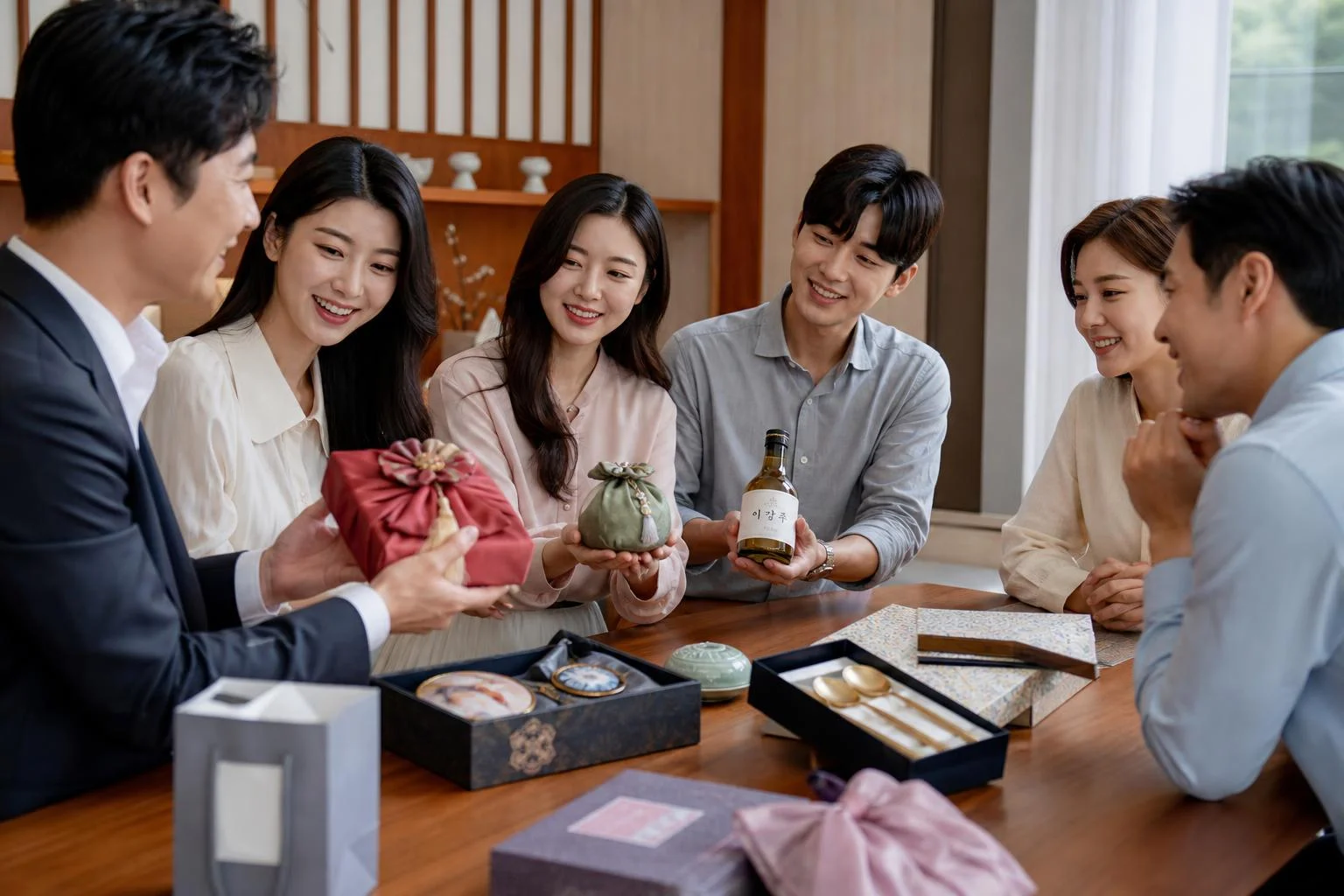
People conversing in front of various Korean gifts
But for a business client or a VIP guest, things get a bit more formal. You might consider elegant gifts like a traditional alcohol set, brassware (Yugi, 유기) soju cups or cutlery, or high-quality tea. And for those with an interest in art and design, a moon jar (Dalhangari, 달항아리) objet or other traditional patterned items would be a fantastic choice.
Generally, a gift budget for a foreign friend is about 30,000 to 100,000 KRW per person, while for VIPs, it can go up to 100,000 to 300,000 KRW.
I think it’s important to remember that if you only bring common items like seaweed or ginseng, your gift might just feel like a tourist souvenir. But if you choose something that’s actually exchanged in Korean homes or at housewarming parties, it naturally opens up conversations about Korean culture, which is so much more meaningful. If you’re looking for more general tips on navigating Seoul, you might find this article on Seoul Subway T-Money helpful for getting around!
Elegant Fabric: Hanbok Pouches and Bojagi
When we talk about traditional Korean clothing, Hanbok (한복) immediately comes to mind. It’s been around since the Joseon Dynasty and is usually worn for special occasions like weddings or traditional holidays now. But for foreigners, it’s often that beautiful outfit they’ve seen in K-Dramas and always wanted to try on! While a full Hanbok set can be quite pricey, locals usually opt for more practical fabric items when giving gifts.
Instead of a full Hanbok, Koreans often choose smaller, elegant fabric items. I’ve seen a lot of people gifting things made from Hanbok fabric, like pouches, wallets, or eyeglass cases. Another popular choice is a quilted silk Bojagi (보자기) pouch. These items typically range from 10,000 to 30,000 KRW each, making them quite affordable and accessible.
Why Hanbok Fabric Gifts are Popular 📝
- Instant Korean Vibe: Traditional patterns like phoenix, peony, or clouds instantly convey a Korean feel without much explanation.
- Practicality: Pouches and cases are useful everyday items.
- Eco-Friendly Story: Bojagi (traditional wrapping cloth) has a beautiful story of being reusable, aligning with modern eco-conscious values.
You can easily find a wide variety of these Hanbok fabric gifts in traditional markets like Insadong (인사동) and Namdaemun Market (남대문시장), or in craft shops in Bukchon Hanok Village. Also, check out traditional culture product shops like those in the National Palace Museum or Gyeongbokgung Palace, and online at the K-Heritage Store. They have so many beautiful options!
Small Treasures: Traditional Design Goods
Beyond fabric, there are these amazing small treasures that pack a strong punch of Korean identity. Think about Jage (자개), or mother-of-pearl inlay. It’s a traditional craft where crushed seashells are painstakingly applied to wood and finished with lacquer. While it was once used for fancy furniture, it’s now being creatively reinterpreted into modern items like Jage stickers, phone cases, keyrings, and mirrors.
I’ve seen many online blogs and craft platforms mention Mugunghwa (무궁화, national flower of Korea) Jage stickers as a popular gift for foreigners. The vibrant colors of the Mugunghwa combined with the iridescent shimmer of mother-of-pearl make for a small but powerful Korean statement piece. These items are usually quite affordable, ranging from 5,000 to 20,000 KRW, making them perfect for gifting to multiple people.
| Traditional Design Gift Ideas | Price Range (KRW) | Unique Feature |
|---|---|---|
| Jage Stickers, Keyrings, Small Mirrors | 5,000 – 20,000 | Iridescent mother-of-pearl, easily portable |
| 12 Zodiac Animal Hand-Carved Stamps | 30,000 – 70,000 | Personalized with recipient’s zodiac sign and name |
| Dokkaebi (도깨비) Motif Items (magnets, plaques) | Varies | Connects to Korean folklore, great conversation starter |
Other elements that really capture attention are Dokkaebi (도깨비) motifs, fish wind chimes, or characters representing the 10 symbols of longevity (십장생) or 12 zodiac animals (십이지신). For example, the 12 zodiac animal handmade stamps are wonderful because you can choose the recipient’s zodiac sign and even engrave their name, usually costing around 30,000 to 70,000 KRW. These traditional design goods are readily available in places like Insadong, Bukchon Hanok Village, the National Palace Museum shops, and various online craft malls.
Home Comforts: Korean Tableware and Living Items
If you want to give a gift that truly reflects Korean everyday life, then tableware and living items are a fantastic choice. Yugi (유기), or traditional brassware, made from a blend of copper and tin, is a prime example. Brassware spoon and chopstick sets are still very common gifts for weddings, housewarmings, or formal family meetings in Korea. It’s considered a sign of good health and prosperity, which I think is a lovely sentiment to share.
Brands like Geochang Yugi (거창유기) for soju or whiskey glasses, or Myeongseong Yugi (명성유기) for cutlery sets, are actually used in Korean households. These are often recommended as gifts for foreigners because they represent authentic Korean living. A Yugi cutlery set, including spoon rests and small plates, typically costs around 50,000 to 150,000 KRW. Whiskey or soju glass sets usually go for about 100,000 KRW. They make fantastic gifts for business partners or VIPs, carrying the meaning of “real Korean household items.”
Popular Korean Home & Living Gift Ideas 🏡
- Yugi Cutlery Sets: Symbolize health and tradition, a staple in Korean homes.
- Hanok Incense Holders & Sticks: Combine traditional Korean house (Hanok, 한옥) aesthetics with calming scents.
- Hanji (한지) or Hangeul (한글) Designed Coasters/Mugs: Practical items with unique Korean cultural touches.
Another item that’s gaining popularity is the Hanok (한옥) themed incense stick holder and incense set. These holders often mimic the beautiful roofs, tiles, or window patterns of traditional Korean houses, and you can pair them with Korean-made incense. They typically cost between 30,000 and 70,000 KRW. Koreans frequently give mugs, wine glasses, diffusers, or coasters as housewarming gifts. Applying this same pattern to gifts for foreigners—choosing living items with Hanok, Hangeul (한글), or Hanji (한지) designs—is a great way to offer both practicality and a touch of Korean elegance. If you’re exploring the latest trends in Seoul, you might also be interested in what’s hot in Seongsu-dong, the new Gangnam.
A Taste of Tradition: Korean Alcohol Gifts
For those who appreciate a good drink, traditional Korean alcohol (전통주) makes for a sophisticated and memorable gift. It’s a consistent bestseller during holidays and special occasions in Korea. Lately, many premium traditional alcohol brands have emerged, focusing on beautiful design and rich storytelling, making them perfect for foreign guests. It’s definitely more than just Makgeolli (막걸리)!
One popular example often mentioned as a top traditional alcohol gift is the Gyesan Baekilju (계룡백일주) set (600ml x 2 bottles). This distilled liquor is made using traditional methods passed down in the Gongju (공주) area of Chungcheongnam-do (충청남도). A gift set usually costs around 50,000 to 70,000 KRW. You can also find various types of traditional alcohol from local breweries, such as:
Types of Korean Traditional Alcohol 🍶
- Takju (탁주): Cloudy rice wine, including Makgeolli (막걸리).
- Yakju/Cheongju (약주/청주): Clear, refined rice wine.
- Gwasilju (과실주): Fruit wines made from plums, peaches, omija berries, etc.
- Jeungryu Soju (증류 소주): Distilled soju, a clearer and often stronger spirit than regular green-bottle soju.
These are often sold in elegant packaging at department stores, traditional alcohol specialty shops, and airport duty-free stores. Koreans often pair alcohol with a set of traditional cups, whether they’re glass or brassware (Yugi, 유기) cups with traditional patterns. These sets typically cost between 70,000 and 150,000 KRW, making them a very respectful gift for business associates. However, it’s always a good idea to discreetly check if the recipient drinks alcohol due to religious or cultural reasons, as Koreans are mindful of this detail. You can learn more about Korean alcohol gift recommendations from various sources.
Gifts with a Story: Symbolic Korean Items
Sometimes, the most memorable gifts aren’t just practical; they carry a strong story and rich symbolism. This is another category of gifts that Koreans often choose. These gifts offer not just an item, but a piece of Korean history and folklore.
Let’s talk about the Buk-eo (북어), or dried pollock, for warding off bad luck. Traditionally, Koreans would hang a dried pollock over their front door to keep away misfortune. Now, you can find small decorative Buk-eo ornaments, usually costing between 10,000 and 30,000 KRW. They make a lovely gift, especially when you explain that it wishes the recipient good luck and peace. It’s a subtle way to share a piece of Korean folk belief!
- Dalhangari (달항아리, Moon Jar): A representative icon of Joseon Dynasty white porcelain. These round, empty white jars symbolize Korean aesthetics. While antiques are incredibly valuable, smaller replicas, objets, or mood lamps are available for 30,000 to 100,000 KRW. They are perfect for those interested in art and design, offering a “Korean aesthetic in an object.”
- Punggyeong (풍경, Fish Wind Chime): These beautiful wind chimes, often seen hanging from temple eaves or Hanok (한옥) roofs, are believed to clear away worldly worries with their pure sound. Fish-shaped Punggyeong are particularly symbolic in Buddhism, representing wakefulness and diligence. Small metal or ceramic Punggyeong cost about 20,000 to 50,000 KRW and are popular as decorative gifts for entrances or windows.
I personally love these symbolic gifts because they go beyond just being pretty objects. They provide a natural segue into explaining “why this is hanging in a Korean home” and sharing fascinating stories about Korean folklore, Buddhism, and aesthetics. It’s a wonderful way for locals to give a gift that also sparks curiosity and conversation about their culture. For more unique travel gift ideas, you might want to check out this Trip.com blog on Korean souvenirs.
📚 Recommended Articles
Frequently Asked Questions ❓
So there you have it! Moving beyond just seaweed opens up a whole world of thoughtful and unique Korean gifts that locals truly appreciate. Whether it’s an elegant Hanbok (한복) fabric pouch, a shimmering mother-of-pearl (Jage, 자개) item, a beautifully crafted brassware (Yugi, 유기) set, a sophisticated bottle of traditional alcohol, or a symbolic good luck charm, each gift carries a piece of Korea’s rich culture and history. I hope this guide helps you find the perfect present that creates a meaningful connection and tells a wonderful story.
If you have any more questions or need further recommendations, feel free to ask in the comments below. Happy gifting!