

📋 Table of Contents
Hey there, fellow travelers! Have you ever landed in a new city and felt completely overwhelmed by its public transportation? I totally get it. When I first visited Seoul, navigating its vast subway system felt like a puzzle. Honestly, I made some pretty common mistakes that cost me extra time and money. But guess what? You don’t have to! I’m here to share my experiences and help you use Seoul Subway T-Money like a seasoned local. Ready to dive in and make your Seoul adventure super smooth? Let’s get started!
Understanding Seoul’s Public Transportation System
Before we dig into the mistakes, let’s quickly grasp how Seoul’s public transport works. It’s truly amazing, you know? Seoul, Gyeonggi, and Incheon are all connected by a fantastic integrated transfer system. This means you can hop between buses, subways, and even some light rail lines, all while enjoying transfer discounts.
Seriously, the key concept here is that you pay a base fare, and then additional fees are calculated based on the distance you travel, especially when you transfer. The Seoul Metropolitan Government has been running various policies like transfer discounts and mileage programs since 2015, always emphasizing that “the more you know and use, the more you save.” It’s definitely something to keep in mind!
Seoul Public Transport Key Facts 📝
- Integrated System: Buses, subways, and light rail across Seoul, Gyeonggi, and Incheon.
- Transfer Discount: Get discounts when transferring within a set time (usually 30-60 minutes) for up to 4-5 times.
- Base Fares: Subway is around 1,250 KRW (card), bus around 1,200 KRW (fares may vary).
- T-Money is Standard: It’s the go-to prepaid card or mobile payment for almost all lines.
This system is designed for efficiency, but it can be a bit confusing at first. For instance, the official Seoul tourism site even states that using a T-Money card gets you a 100 KRW discount on bus and subway fares, plus transfer benefits. So, embracing the “prepaid card + distance-based fare + transfer discount” structure, with T-Money at its core, is definitely the smartest approach.
The Trap of Single-Use Tickets: Why T-Money Saves You Money
My first big mistake? Relying solely on those single-use tickets you see at every subway station. They seem easy, right? Just buy one and go. But trust me, it’s a trap! I quickly learned that while convenient for a one-off trip, they’re not friendly for tourists planning to use public transport regularly.
Using single-use tickets means you miss out on so many benefits. Think about it: you waste time at the ticket machine every single time, you have to remember to get your 500 KRW deposit back (which is a hassle!), and most importantly, no transfer discounts! That’s a huge deal for your wallet, especially if you’re exploring different parts of the city.
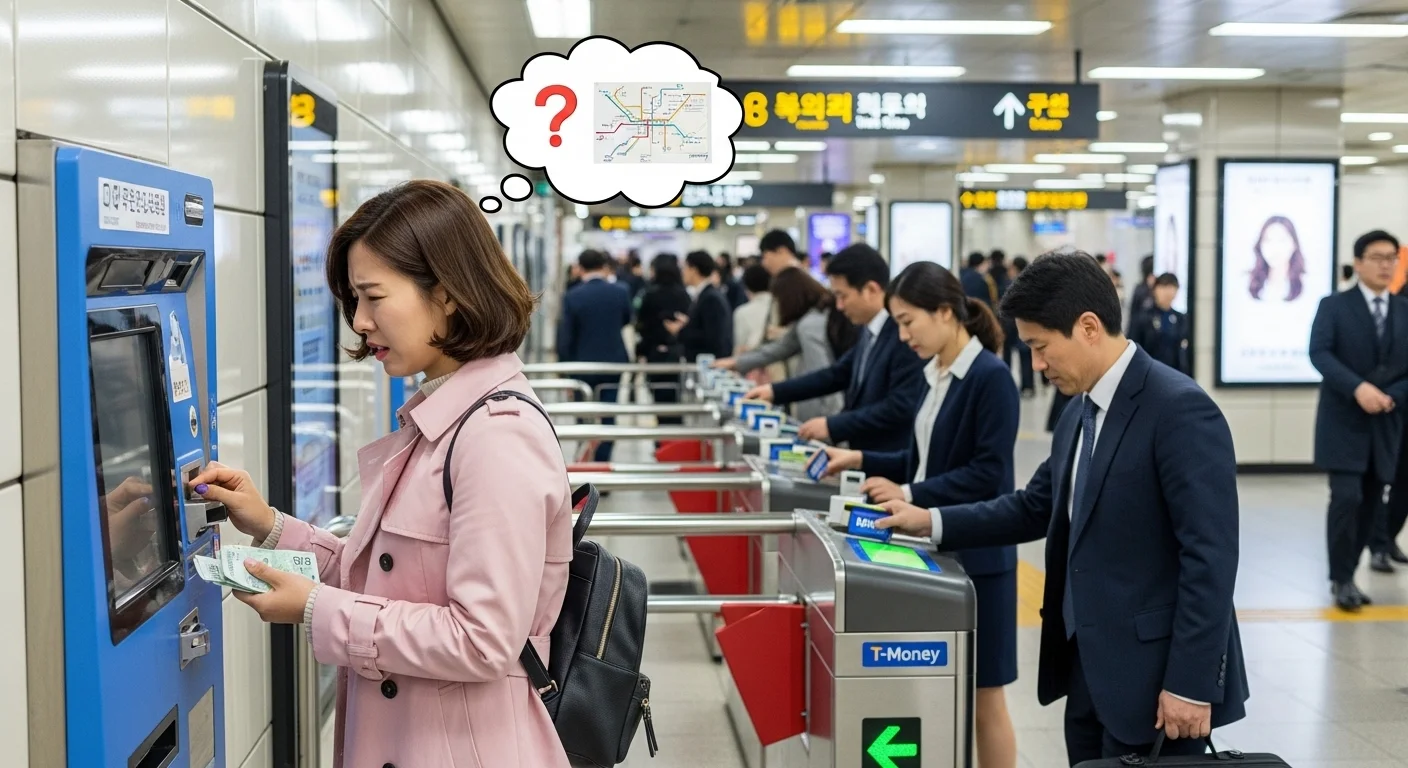
Subway station during rush hour
The financial benefits of T-Money are quite significant. According to Seoul City data, using a T-Money card allows you to accumulate 0.2% mileage on your public transport fares and 2% on your top-up amount, with a maximum of 1,500 mileage points per month. Plus, that 100 KRW discount on each ride? It adds up! Imagine a month-long stay, taking public transport 4 times a day. You’d use it around 144 times, spending roughly 170,000 KRW. All those discounts and mileage points could save you thousands of won. If you only used single-use tickets, you’d miss out on all of it. So, honestly, if you’re in Seoul for more than just a quick visit, not using Seoul Subway T-Money is like throwing money away.
T-Money Transfers: Don’t Forget to Tag Out!
Okay, so you’ve got your T-Money card, awesome! But here’s another common pitfall I stumbled into: understanding the transfer rules. I thought, “Great, I’ll just tap my card once and all my transfers will be automatic!” Oh, how wrong I was! This is super important: you absolutely need to tap your card both when getting on AND getting off the bus or subway.
The integrated transfer discount system works by calculating your total journey distance. If you forget to tap out, the system can’t accurately figure out how far you’ve traveled. This often leads to being charged the longest possible distance, or even worse, a penalty! Plus, your subsequent transfers might not be recognized for the discount. It’s a real bummer when that happens.
Transfer Rule Checklist ✅
- Tap In & Out: Always tap your T-Money card when boarding and alighting.
- Time Limit: Transfers must occur within a specific time frame (usually 30-60 minutes).
- Same Card: Use the same T-Money card for all legs of your journey.
- Early Bird Discount: First tap before 6:30 AM can get you a 20% discount that carries over to transfers!
I know, it sounds simple, but in a crowded subway station, it’s easy to get pushed along and forget to tap out. Or you might think, “Oh, I only need to tap for the bus, not the subway.” Nope! It’s for both. Even for special cards like the ‘Climate Card’ (기후동행카드), forgetting to tag out twice can lead to a 24-hour suspension of your card! So, please remember this simple mantra: “Tap when you get on, tap when you get off.” Stick to that, and you’ll be golden.
Mobile T-Money Setup: Common Errors and Solutions
Mobile T-Money is super convenient, but setting it up can be a bit tricky, especially if you’re not familiar with Korean apps or phone settings. I’ve seen tourists, and honestly, even I’ve had moments standing at the subway gate, wondering why my phone wasn’t recognizing the tap. It’s usually down to a few common setup mistakes.
For Android users, you typically install the ‘Mobile T-Money’ app, enable your phone’s NFC function, and then either issue a prepaid T-Money card directly on your phone or register an existing one. iPhones, on the other hand, have seen expanded support since 2023-2024, generally requiring an iPhone XS/XR or newer and iOS 17.2 or higher. You’ll need to add a prepaid T-Money card to your Wallet app to use it for transport.
Mobile T-Money Troubleshooting 🛠️
| Problem | Solution |
|---|---|
| NFC is Off (Android) | Ensure NFC is enabled in settings and the ‘Mobile T-Money’ app is active. |
| Wrong Card Set as Default (iPhone) | In Wallet app, confirm T-Money is set as your default transit card. Enable Express Mode for quick taps. |
| Thick Phone Case / Metal Material | Remove the case or ensure the top-rear of your phone directly touches the terminal. |
| Outdated iOS Version (iPhone) | Update to iOS 17.2 or higher for full T-Money functionality. |
For Android users, a common blog guide suggests that after installing the ‘Mobile T-Money’ app and topping it up, you need to turn on NFC and tap the back of your phone to the terminal with the purple card screen open. For iPhone users, the key is ensuring your iOS version is up-to-date and that T-Money is set as your express transit card in the Wallet app. If all else fails, the T-Money customer service (1644-0088) or Apple support are there to help.
Tagless vs. Tag: Knowing the Difference
This is a relatively new one, and it can definitely confuse tourists, and honestly, even locals! Since 2023, Seoul has been trialing ‘Tagless’ payment, where you don’t even need to tap your card! It sounds super convenient, right? But it operates differently from the standard tap-and-go system.
Tagless payment was first introduced on the Seoul Ui-Sinseol Light Rail in November 2023. How it works is pretty cool: if you have the ‘Mobile T-Money’ app installed on your smartphone, the subway gate uses Bluetooth communication to recognize your mobile T-Money information and automatically deducts the fare as you pass through. It’s especially handy for people with wheelchairs or those carrying lots of luggage. However, it’s not everywhere yet!
Tagless Payment Key Points 📱
- No Physical Tap: Your phone’s Bluetooth communicates with the gate.
- Mobile T-Money App Required: Must have the app installed and active.
- Limited Availability: Currently in trial on specific lines like the Ui-Sinseol Light Rail. Don’t expect it everywhere!
- Convenience: Great for hands-free travel, but requires awareness of where it’s available.
The main confusion comes when you assume all subway lines have Tagless payment. They don’t! So, if you’re on a line that requires a standard tap, and you try to walk through a gate expecting it to automatically charge you, you’ll likely get stopped. Always check for signs or ask if you’re unsure. For most of your travels on the main subway lines, you’ll still be using the traditional T-Money tap system. Don’t mix them up, or you might end up with an unexpected fare!
Key Takeaways for Seoul Subway Travel
📚 Related Articles
Frequently Asked Questions ❓
So there you have it! Mastering the Seoul Subway T-Money system really isn’t as daunting as it first seems. By avoiding these common tourist mistakes – like sticking to single-use tickets, forgetting to tap out, or messing up your mobile T-Money setup – you can seriously enhance your travel experience. I mean, who wants to waste time and money when you could be exploring more of this incredible city, right? Remember, with a little bit of knowledge and your trusty T-Money card, you’ll be navigating Seoul like a pro in no time. If you have any more questions, feel free to drop them in the comments below. Happy travels!